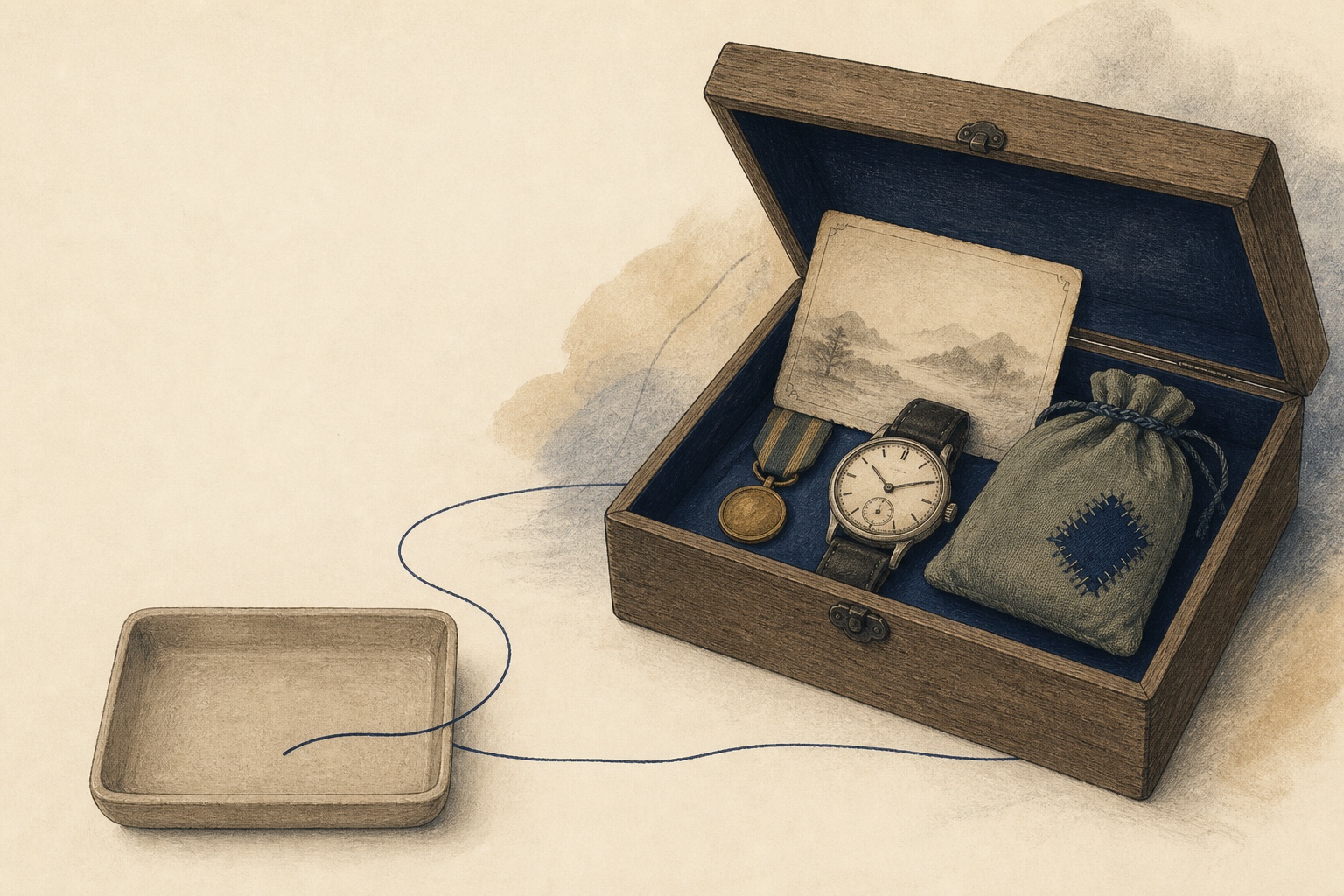

“Reluctance to let go” is often treated as a feeling, as if once the feeling passes the object will leave on its own. Under the same phrase, though, entirely different things may sit: the loss of a relationship, an unfinished choice, proof of having been seen, love for the giver, or longing for someone who has left. Without distinguishing them first, every object receives the same advice: wait until you are ready.
The problem is that “ready” is hard to answer. A person may know they no longer want to keep something, yet not know which part they would be putting down; they may simply not want to decide while being hurried. Turning reluctance into a few questions that can be checked slowly may not produce an answer at once, but it can keep sorting from being only pressure.
First ask what, and for whom, the object is carrying
If the object stands for a relationship that has already ended, what may need attending to is not the box but the loss that relationship left. If it stands for an unfinished dream, keeping it will not necessarily bring time back; before the story has been told, letting the person tell it clearly may be more fitting than clearing it away. Here the object is like a container. What it holds is not function, but meaning that has not yet been placed elsewhere.
Some objects prove that a person once worked hard, was affirmed, or once held a certain identity. Then one can ask: does life now still need this object as evidence? There is no need to deny the past, and no need to keep every proof. Keeping one representative piece, taking a photograph, writing the story down: all are possible ways to shift. Which one fits is still for the person to decide.
Love and longing also do not have only one way to continue. Keeping something nearby, storing it together, telling the story to someone else, or handing a still-usable object to the next person who needs it may all let a relationship remain in a different form. One cannot infer from another person’s practice that someone else should finish on the same timetable. That someone sorted memorial objects quickly only means that was their choice, not a schedule for everyone.
Do not treat the five clues as an emotion test
Loss, regret, being affirmed, love, and longing can serve as entries for observation, but they are not a complete classification and not a psychological assessment. Reluctance may also come from needing a spare, unclear ownership, unwillingness after a wrong purchase, or simply not having enough time yet to confirm the next step. If the five clues are presented as the only answer, the person is pushed into another frame.
Questions can be small: does this object still have a use now? If not, is what it keeps a story, a relationship, an identity, or future uncertainty? Is there a way to preserve it that does not make the whole space its warehouse? If it is to go to a next user, who has the right to decide, and who can confirm receipt? The point of the questions is not to force letting go, but to break a vague reluctance into parts that can be negotiated.
A circular view belongs here too: leaving the home need not mean becoming waste. Usable objects can continue in use with consent and a suitable recipient; stories can remain in words or images; only objects that have truly lost function enter an appropriate disposal path. Understand the meaning first, then decide the form, so that rushing to empty a space does not discard value that can still continue.
So there is no need to keep asking “Am I ready?” One can ask first: what is this object carrying for me now? If that meaning has another way to be kept, am I willing to try it? The answer need not be finished today, but once the questions change, sorting has a chance to move from pressure to choice.
One can also arrange a small next step for each kind of answer: if the story is unfinished, write a few sentences first; if only preservation is needed, choose one representative piece first; if it still has use, first confirm who is willing to take it; if others’ ownership is involved, obtain consent first. These steps will not complete farewell for the person, and they cannot guarantee that feeling will loosen at once, but they can keep an object from remaining forever in the same place. When choices become visible, keeping and leaving both become decisions with conditions.

💬 Comments
Loading...