
“So you are no longer a slave, but a son; and since you are a son, God has made you also an heir.”
— Galatians 4:7
TL;DR: In 2003 I graduated from China Evangelical Seminary with an M.Div. My first ministry-related role was as part of an editorial team on a cross-border project at the Bible Society. The Galatians Study Bible was the volume I helped pull together: my job was to gather the Bible scholars’ textual research, pass it up to the general editor, and shape it into a commentary.
Years later, reopening that “28th Proof” copy, I find that the meditation questions I once wrote for readers now turn and ask me; the verse in Galatians — “you are no longer a slave, but a son” — still moves me deeply. The feeling has two layers: one is the words, the other is the trace of a personal history. Nothing in a life is walked in vain. Those seemingly scattered beliefs, the waiting, the losses, the callings — at some moment they all join into a single line. And then you know: you are not being pushed along by the past, but drawn forward by a deeper calling.
On my screen is a PDF. Along the bottom, in very small type, it reads Galatians-28thProof.indd, timestamped 2009/11/17 at 12:31 p.m. The 28th proof. A proof that had been typeset through twenty-eight rounds of correction, still bearing a “For Review Use Only” watermark, never formally published. I stared at that line of small text for a while — because those were the hands of my younger self.
In 2003, I received my Master of Divinity from China Evangelical Seminary. The seminary’s formation immersed me for years in the language of exegesis, preaching, and pastoral care, and it showed me that ministry does not only happen from a pulpit. Afterward, I didn’t enter parish ministry. Instead, I sat before a computer and served as one of the editors on a study Bible project for the Bible Society.
After Theological Training, My First Role Was at an Editorial Desk
The study Bible was a major undertaking. Each biblical book had a primary editor responsible for that volume, and everyone served as part of the editorial team, accountable to the general editor. The volume assigned to me was Galatians. A body of material arrived in my hands — biblical scholars’ work, linguistic scholarship, divergent interpretations — and my task was to read all of it, digest it, arrange it in sequence, and synthesize it into a book that an ordinary believer could pick up and follow.
Open any page of the commentary and you can see how the tools were woven together. Running alongside the main text were cross-references, threading related passages together one by one. Below those sat dense annotations explaining that “the slave woman” and “the free woman” referred to Hagar and Sarah, and that the Greek phrase rendered “the basic principles of the world” carries four possible meanings. Along the side, blue-boxed “Reflection” prompts offered readers a question to carry away. None of this would bear my name. Yet the breathing rhythm of the whole — where to pause, where to offer one more sentence, where to place a photograph of Mount Sinai — was something I was tuning.
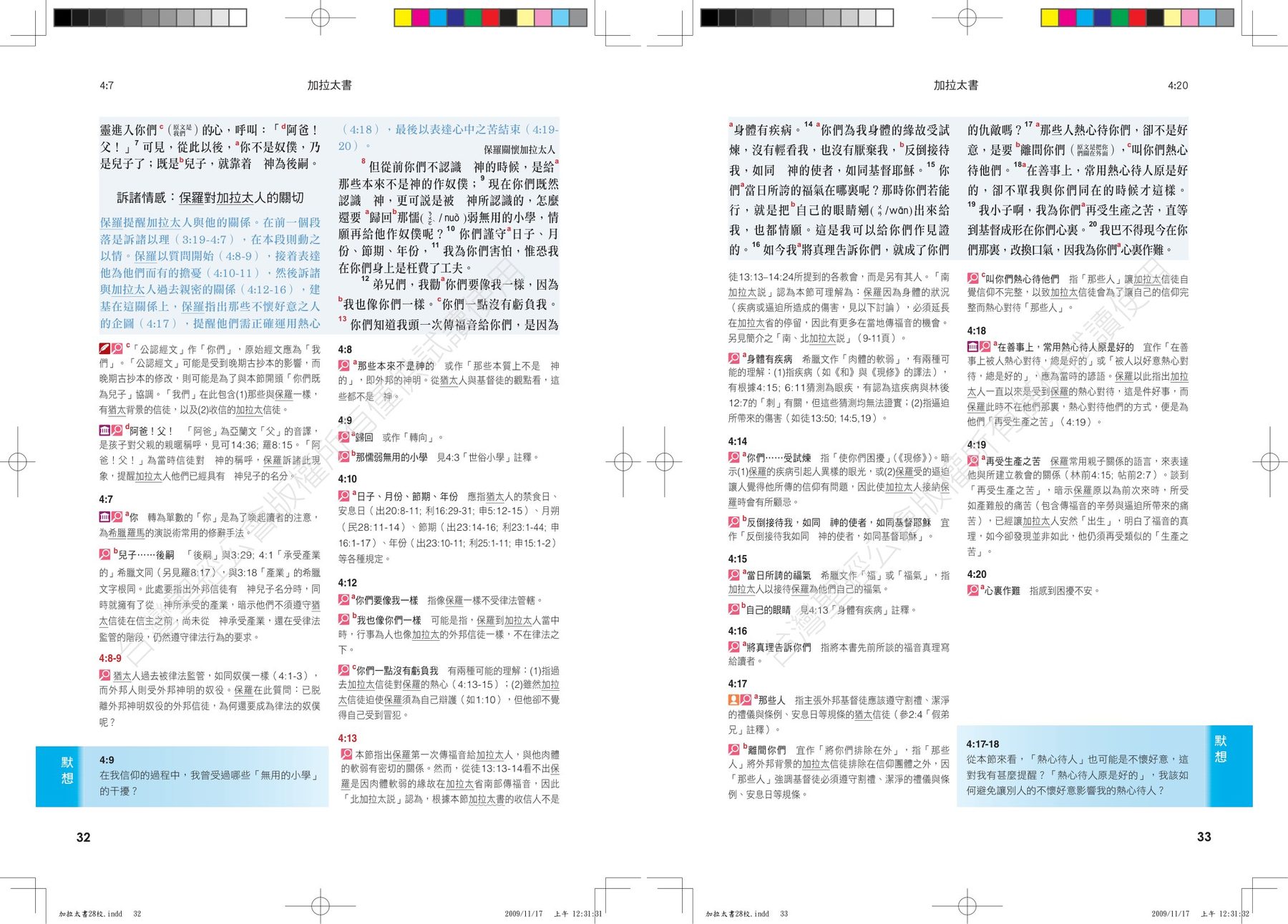
Pages 32–33 of the 28th proof of the Chinese Union Version Study Bible: Galatians, showing the interwoven layers of cross-references, annotations, and blue “Reflection” prompts. © Bible Society of Taiwan.
I worked at both ends of this craft. At one end was the scaffolding: the outline for each volume, the “Book Overview” essay that opened each book — I wrote those by first reading through an entire book’s worth of scholarship, digesting it, and recomposing it. For the Genesis overview alone, I had to map out how the whole book was structured and how each section connected to the next before I could write those few hundred words. At the other end was painstaking handwork: when importing a Word document into the layout software, hundreds of footnote markers had to be replaced with graphic icons one by one; whether a numeral’s horizontal scale should be set to 90 or 100 percent was something I wrote into a personal style sheet, so I wouldn’t fall into the same trap next time.
What, Exactly, Goes into Editing a Study Bible?
By the 28th proof, you are no longer correcting typos.
Getting to twenty-eight rounds means years of back-and-forth. A revised draft goes out; some time later it returns to my desk carrying new red marks, new queries, and a note saying “perhaps reconsider this” — so it gets revised again, sent out again, and you wait for the next round. The work was astonishingly slow, slow enough that there were moments when you forgot it would ever have an ending. I sat down to begin editing in 2003; this proof stamped “2009, 28th proof” represents how many intervening versions I couldn’t begin to count.
And it wasn’t only Galatians. Within the same study Bible series I edited volume after volume: Genesis, Ruth, Colossians, Philemon, 1–2–3 John. Each volume typically passed through several reviewers before the revisions were integrated into a final text.
The early proofs were about catching errors: punctuation, whether scripture citations were accurate, whether Greek transliterations were consistent. The middle rounds began grinding toward readability: Is this annotation too academic — should it be rewritten for a general reader? Does this illustration help or confuse at this point? The Hagar-and-Sarah passage is too dense — how do you lay the groundwork so it doesn’t frighten people off? By the later stages, what you are refining is almost a disposition. Whether to use one word or another comes down to how deeply you respect the reader.
The hardest decision in gathering a community of experts’ voices was deciding what not to include. Behind every annotation I kept were several I removed.
The Reflection Questions I Once Wrote for Readers Still Have Something to Say
Reopening this proof recently, what truly made me stop were those blue “Reflection” prompts.
Alongside Galatians 4:9, one prompt asks: “In the course of my faith journey, what ‘weak and miserable principles’ have interfered with my growth?” The prompt beside 4:17 asks: “How can I keep others’ ill intentions from dimming my own warmth toward people?” The one beside 3:28 is more direct: “How should I treat Christians of different ethnicities, social classes, and genders?”
These questions were written for readers. At the time, I stood outside the questions — my role was to design them carefully and then move on to the next passage.
Reading them again after all these years, I am no longer only the one who set them.
Which “weak and miserable principles”? The things that once consumed me without truly building me — I can name some of them. Have others’ ill intentions ever cooled my warmth toward people? The words have not changed; the reader has. Perhaps what a study Bible truly leaves behind is not only explanation, but the questions that remain alive on the page.
The Thread That Never Broke
Those ten years of editing and translation work taught me to reflect theologically through language — to let words become a form of quiet companionship. If a sentence could help a reader understand a little more, feel a little more comforted, or take one more step forward in faith, then all those cycles of revision and careful weighing had their meaning.
That formation carried a cost. After years of proofing commentaries, my own writing became stiff. Sometimes it reads like a textbook. There is no getting around it — I spent years immersed in the compilation and translation of biblical commentary, and the habit of “being accountable for every word” is not something you simply shed.
So for me, this essay is less an act of nostalgia than a turning-back to notice a thread that was never wholly severed. Once my work lived inside a manuscript, keeping a book company as it slowly took shape; now, with the help of technology, it is about letting more words speak to one another, and drawing my own experience, understanding, and memory into a deeper order. The human situation is, in the end, nothing but a conversation between oneself and the world: open yourself, and the world answers; shut the door of your heart, and even the finest opportunity cannot come in. That, too, is why I have placed this piece under “Contemplation and Memory”: not merely as the recollection of an editing past, but as something closer to meeting again, after many years, the classic text, my own self, and the road that a life has walked.
On the day of the 28th proof, I did not know whether a 29th would ever follow. That line I proofread over and over, “you are no longer a slave, but a son,” still raises ripples in me when I read it now, years later. The words that once passed through those manuscripts have quietly passed through my life as well; they did not stay on the page alone, but sank into memory, into conviction, into the body, and became a part of who I am.
Galatians 4:7 as a lo-fi worship loop — “From Now On (Child & Heir)”.

💬 Comments
Loading...