70,267.
The moment the program finished running, this number appeared on the screen. I stared at it for a few seconds—I had pressed the shutter button over seventy thousand times on my phone, and every single one could be accounted for with crystal clarity. Each time, it was a moment when I felt the world before my eyes was worth preserving.
An Accidental Digital Archaeology
I started using Claude’s Cowork feature in January this year, originally just wanting AI to help me handle those long-procrastinated trivialities on my computer—file organization, subscription integration, various technical debt. Unexpectedly, the collaboration efficiency far exceeded expectations. Things that had been indefinitely postponed due to busyness were rapidly assembled like building blocks. Following the schedule, this week it was time for years of accumulated photos.
Over seventy thousand. Working with AI, I wrote a Python script to read each photo’s metadata, analyze year distributions, extract geographic coordinates, and finally output a JSON report. The process wasn’t smooth—without proper workflow setup, my computer crashed several times. But after seeing that report, it felt less like organizing files and more like conducting an excavation of life’s trajectory.
The Shape of Time’s Curve
The year distribution chart that emerged drew a curve I hadn’t anticipated.
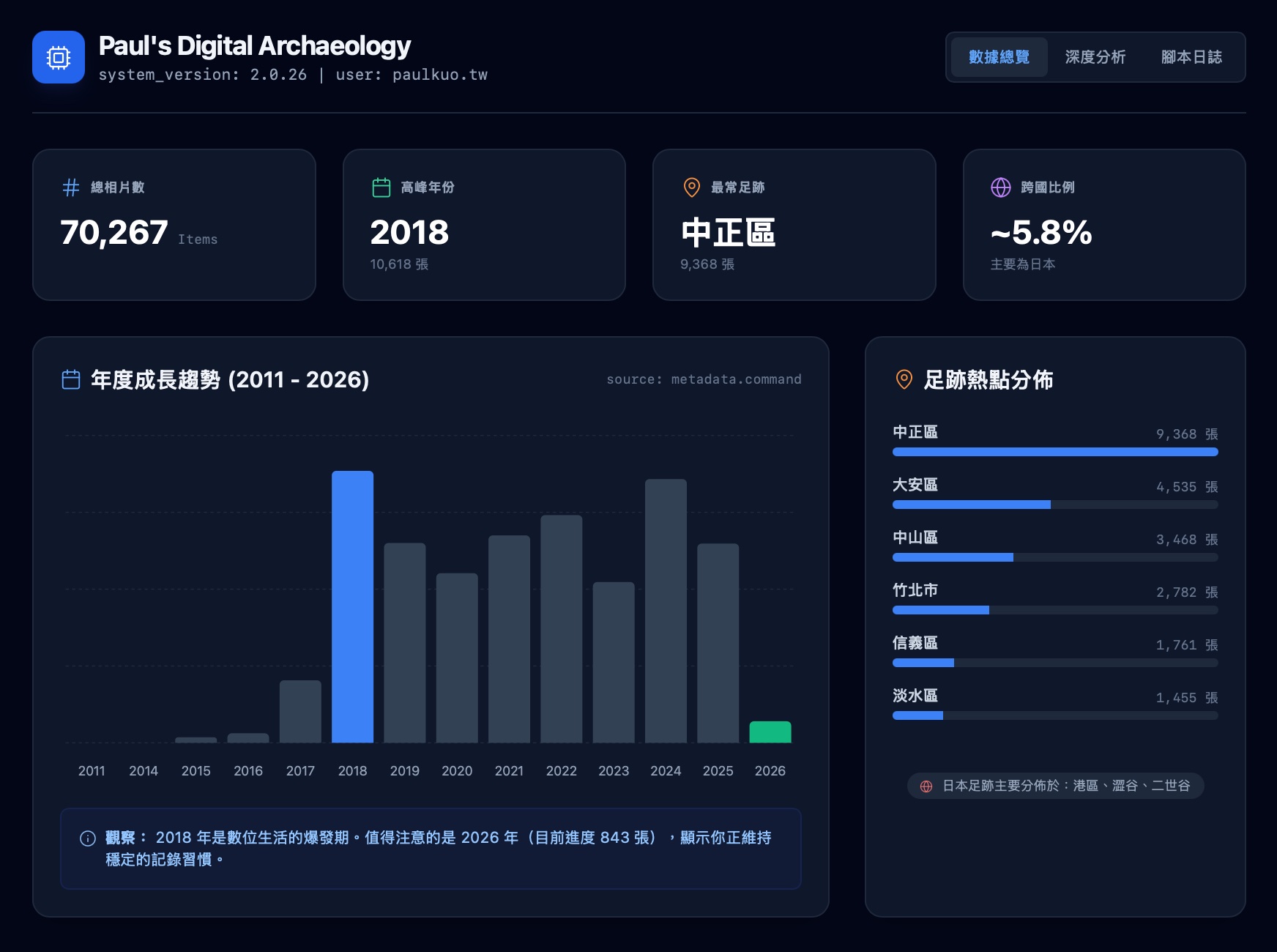
2015 and 2016 were relatively steady, with stable photo counts. But by 2018, the data suddenly exploded upward. Looking back, that was precisely when my life’s rhythm began accelerating—new opportunities, career pivots, the most frequent cross-border movements, cities changing, scenes shifting, work transforming, travels and encounters intersecting across different coordinates.
Some say that after fifty, life gradually converges: activities decrease, movement distances shrink, life tends toward stability. I once thought so too. But spreading out the data, I discovered my activity density hasn’t decreased but increased. This isn’t some inspirational “eternal youth” narrative, but a fact the data told me. I haven’t been converging.
This made me think of something: our narratives about our own lives are fluid. Not because we deliberately distort them, but because memory itself isn’t a reliable database.
Metadata’s Honesty
Memory deceives. Details get worn smooth by time, stories get reinterpreted by current emotions. You remember a trip as “probably summer,” but metadata tells you it was November. You feel a certain period was “quite mundane,” but photo density says it was actually your most active year.
There’s a concept in theology I’ve always found compelling: human understanding of their own circumstances is often constrained by present feelings rather than facts. Augustine spent considerable space in his Confessions addressing the relationship between memory and time—in modern terms, he meant: memory isn’t a copy of the past, but the present’s reconstruction of the past. Sixteen hundred years later, metadata confirms this in another way: timestamps and GPS coordinates in image parameters don’t get rewritten by emotions. A foreign street, a meeting, a journey, a special photo—they rest quietly in file parameters, far more honest than our minds.
This is what makes photo organization interesting to me. On the surface, it’s archiving images, but actually it’s converting fuzzy memories into searchable data. Building an index for your own time.
From Recollection to Query
Our generation’s memory no longer needs to rely solely on brain cells for preservation. It can simultaneously exist in phone albums, cloud drives, social media posts, health tracking apps. With precise times and locations, migration trajectories between cities, social graphs between people, and moods from the moment the shutter was pressed. In some cases, it can even integrate with physiological data—for instance, if I wanted to cross-reference, my Fitbit data could tell me what my heart rate was when a certain photo was taken.
When these fragments are organized, parameterized, and structured, they’re no longer just “memories.” They become something searchable, cross-referenceable, reorganizable. Your relationship with your past changes from “I remember…” to “Let me check…”
In building paulkuo.tw, I realized something: when people systematically output their experiences, perspectives, and trajectories, they’re no longer just living through them, but transforming the traces of having lived into a form of indexable existence. Photo organization is another facet of the same thing.
An Index for the Future
Watching images transform into data structures, I pondered a question: ten, twenty years from now, when I look back at the “past,” what will I be able to find?
It’s not entirely a sentimental question, but a very practical one—if the future me needs to retrieve certain fragments, has the present me left sufficient indexing? Time will continue flowing, memory will continue blurring, but if the data structure remains, those moments once deemed worth preserving won’t completely disappear into time (if my flesh decays, can my memory agent still be renewed in mind and transformed? I don’t yet know).
Over seventy thousand time nodes. Behind each one is some second’s worth of attachment or the lingering warmth of exchange. They won’t remember what I was thinking then, but they remember where I was, when, facing which direction, what I was missing, what I cared about.
Perhaps that’s enough. The rest I’ll leave for the future me to fill in.

💬 Comments
Loading...