
TL;DR — Zolgensma at NT$49 million per dose, Kymriah at NT$8 million, Upstaza at NT$100 million. Minister Shih Chung-liang said new technologies bring immense hope — and immense pressure on the financial system. His answer is to bring costs down: the same therapy, if conducted in Taiwan, would run “roughly half or less, even one-third.” Getting there requires clinical trials that actually move. His target: 180 days from application to enrollment.
This is the third installment of three, covering slides 16 through 20 and the latter portion of the lecture. Part 1 addressed the global market and Taiwan’s positioning. Part 2 covered the dual-track system and the mechanics of conditional approval. This piece takes up the three practical questions: money, speed, and where all of this is ultimately headed.
A note on sourcing
- Direct quotations are from Minister Shih’s remarks, transcribed from the lecture recording.
- Unquoted statements draw from the slides or the full transcript. Where the Minister said something verbally that does not appear in the slides, this is noted.
- My own judgments and inferences are gathered at the end under “Editor’s Observations” and kept out of the main text.
How many regenerative medicine products has Taiwan approved?
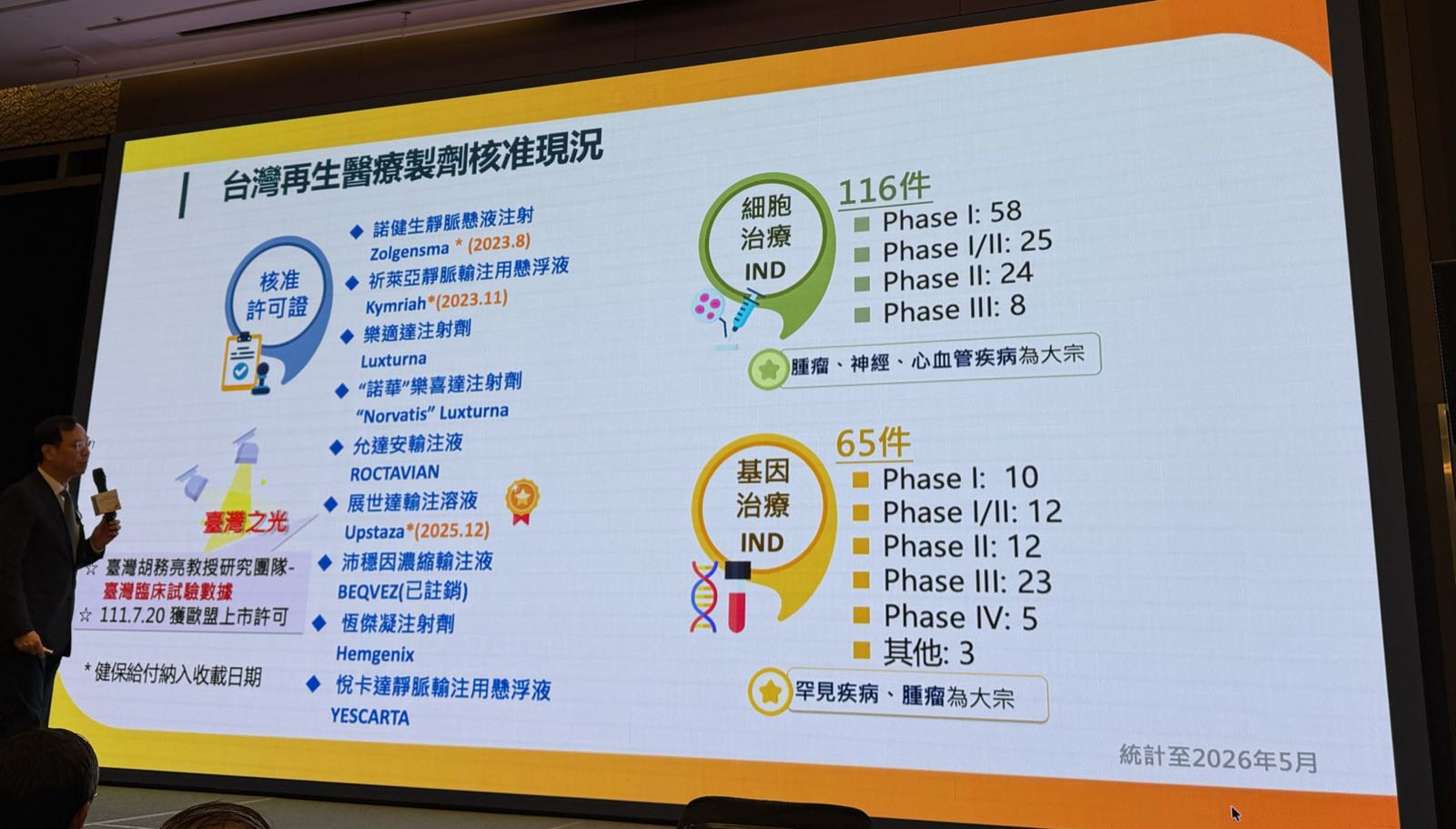 Slide 16 Current Status of Approved Regenerative Medicine Products in Taiwan
Slide 16 lists nine cumulative marketing authorizations, one of which has since been deregistered. An asterisk marks the NHI coverage inclusion date:
| Product | NHI Coverage |
|---|---|
| Zolgensma (諾健生靜脈懸液注射)* | 2023.8 |
| Kymriah (祈萊亞靜脈輸注用懸浮液)* | 2023.11 |
| Luxturna (樂適達注射劑) | — |
| Luxturna — Novartis (「諾華」樂喜達注射劑) | — |
| ROCTAVIAN (允達安輸注液) | — |
| Upstaza (展世達輸注溶液)* | 2025.12 |
| BEQVEZ (沛穩因濃縮輸注液) — deregistered | — |
| Hemgenix (恆傑凝注射劑) | — |
| YESCARTA (悅卡達靜脈輸注用懸浮液) | — |
The slides list only product names and NHI coverage dates, without product category labels. In the lecture, the Minister named three verbally: Zolgensma as a gene therapy for SMA, Kymriah as a CAR-T therapy, and Upstaza as a gene therapy.
The slides single out Upstaza as a point of national pride. It originated from the research team of Professor Wuh-Liang Hwu, used Taiwanese clinical trial data, and received EU marketing authorization on July 20, 2022.
How many cell and gene therapy trials are currently underway?
The same slide provides IND statistics as of May 2026:
Cell Therapy INDs: 116 total
- Phase I: 58
- Phase I/II: 25
- Phase II: 24
- Phase III: 8
- Oncology, neurology, and cardiovascular diseases are the leading areas
Gene Therapy INDs: 65 total
- Phase I: 10
- Phase I/II: 12
- Phase II: 12
- Phase III: 23
- Phase IV: 5
- Other: 3
- Rare diseases and oncology are the leading areas
(The four cell therapy phase categories sum to 115, one short of the 116 shown in the slide. The slide does not include an “Other” row for cell therapy, so the discrepancy cannot be attributed. For gene therapy, the five phase categories plus “Other” sum to 65, matching the total.)
Minister Shih’s comments on this slide:
“These are the application criteria — just for your reference. On the right you can see the clinical trials currently underway in Taiwan: cell therapy on top, gene therapy below. The numbers are decent, but not enough. We’d like to see a lot more. Phase III cases are relatively hard to come by. The caseload before Phase II is actually quite substantial.”
“So what we want to do is take this advantage and accelerate it — then pair Phase I and Phase II results with conditional approval to enable early access. That is our strategy.”
He used the phrase “overtaking on the inside lane” to describe this approach:
“As I mentioned, Taiwan’s advantage lies in Phase I and Phase II, because Phase III case numbers are comparatively low. So we need to focus on early-phase trials. Early attainment of endpoints, early application — that is the key to overtaking on the inside lane.”
(Conditional approval has five statutory criteria. The one relating to trial phase requires completion of Phase II clinical trials, with a risk-benefit review confirming safety and preliminary efficacy. The full text of all five criteria appears in Part 2.)
What does a dose of Zolgensma, Kymriah, or Upstaza cost?
Minister Shih quoted prices for three products on the floor. These figures were spoken verbally and do not appear in the slides.
“The one at the top, Zolgensma — that’s a gene therapy, for SMA — is NT$49 million per dose. The second one, Kymriah, is a CAR-T therapy, NT$8 million per dose. And Upstaza at the bottom, another gene therapy, NT$100 million per dose.”
“You might wonder why there are so few. Every single one of these is extraordinarily expensive. New technologies bring limitless hope — but they also put pressure on the financial system.”
He did not mention prices for the remaining six products, and the slides carry no individual pricing figures.
How much cheaper would the same therapy be if conducted in Taiwan?
The Minister then turned to cost. The following is from his verbal remarks and does not appear in the slides.
“So why do we want to develop this capacity? Because if we can bring it onshore — Taiwan’s greatest strength is cost. We can be small but excellent. The same therapy, if treatment is conducted in Taiwan, would come to roughly half the price or less, even one-third. That’s what we can achieve. If we want more people to benefit from advanced medicine, we have to accelerate the pace at which our clinical trials can take root.”
He did not explain the basis for this ratio, nor did he specify which market he was comparing Taiwan against.
Where does the 180-day target come from?
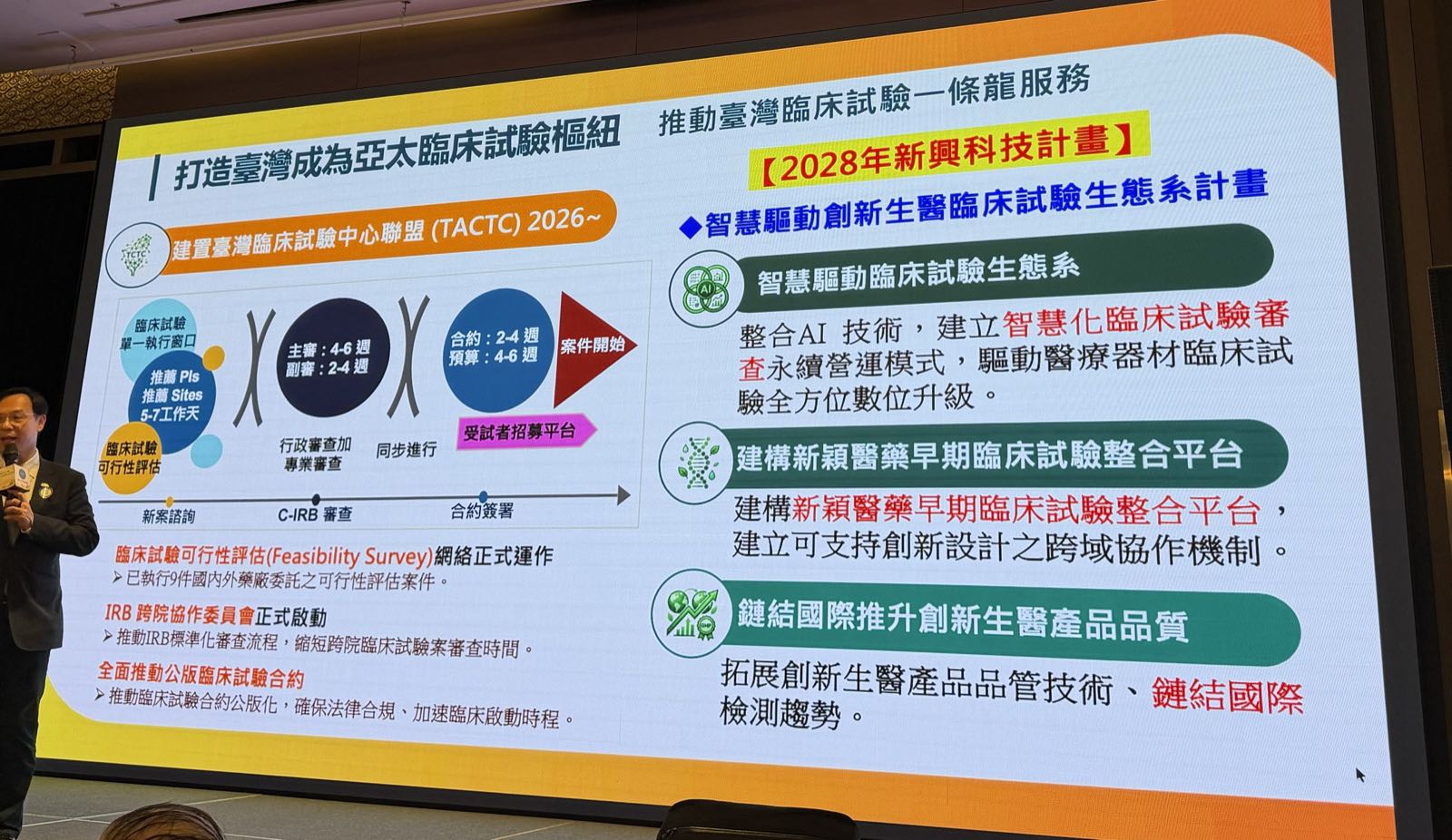 Slide 17 Building Taiwan into an Asia-Pacific Clinical Trial Hub
The Minister put a timeline to the ambition. The “180 days” figure was spoken verbally and does not appear in the slides.
“We are working on an end-to-end, integrated approach to clinical trials — streamlining it into a single pipeline. We need to shorten the timeline. I said something about a year earlier; my actual goal is for the time from application to the start of enrollment to be within 180 days.”
“To move faster, we have to work together: simplify the earlier steps, accelerate IRB review, front-load contract work, digitize enrollment at the back end — and then connect it all across multiple sites.”
(Per the transcript editor’s note, a partial sentence follows the “180 days” figure in the recording, but the two audio sources disagree on the number and no determination was possible, so it has been omitted here. The earlier reference to “a year” does not have a clear antecedent in the transcript.)
Slide 17 presents the TACTC (Taiwan Clinical Trial Consortium) framework, operational from 2026, with three timeline targets:
New Case Consultation
- Single point of contact for clinical trials
- Feasibility assessment
- Recommending PIs and Sites: 5 to 7 business days
C-IRB Review
- Primary review: 4 to 6 weeks
- Secondary review: 2 to 4 weeks
- Administrative and professional review conducted concurrently
Contract Execution
- Contracts: 2 to 4 weeks
- Budgets: 4 to 6 weeks
- Patient recruitment platform also established
Three initiatives already underway:
- Clinical trial feasibility assessment network is operational, with 9 feasibility evaluation cases completed for domestic and international pharmaceutical companies
- Cross-institutional IRB collaboration committee has been formally launched, promoting standardized IRB review procedures
- Standardized public-version clinical trial contracts now being implemented across the board, to ensure legal compliance and accelerate trial startup
The same slide also describes a 2026 initiative under the Smart-Driven Innovative Biomedical Clinical Trial Ecosystem Plan, covering intelligent clinical trial review, an integrated early-phase trial platform for novel therapeutics, and international linkage to raise the quality of innovative biomedical products.
What the slide designates as “concurrent” is the administrative and professional review within the C-IRB phase.
National Development Fund: Four Core Strategies
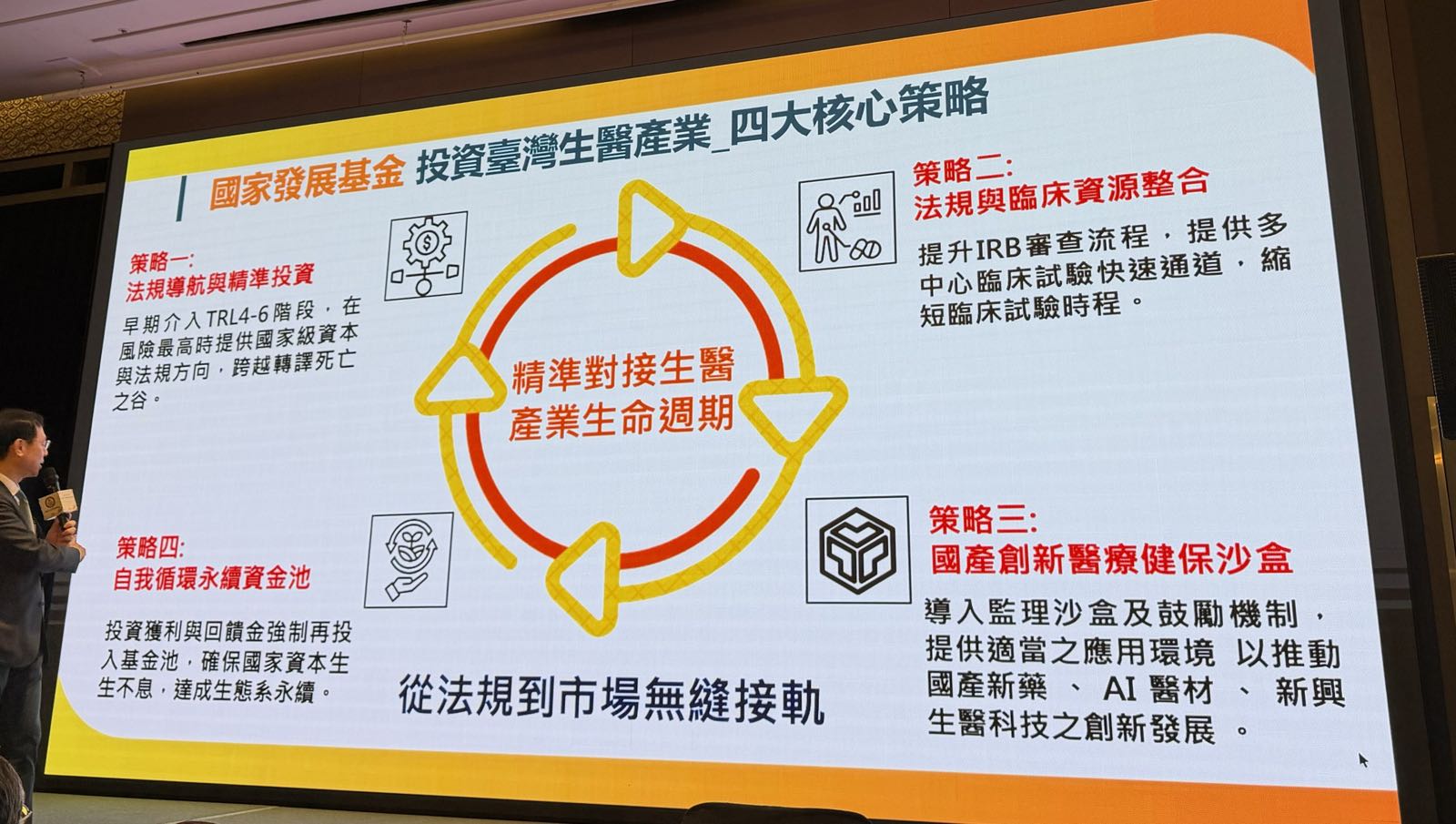 Slide 18 National Development Fund Investment in Taiwan’s Biomedical Industry: Four Core Strategies
The overarching goal is precise alignment with the biomedical industry lifecycle, from regulation through to market — with no gaps in between.
Strategy 1, Regulatory Guidance and Targeted Investment: Early-stage intervention at TRL 4 to 6, providing national-level capital and regulatory direction at the highest-risk phase, to bridge the “valley of death” in translation.
Strategy 2, Integration of Regulatory and Clinical Resources: Improving IRB review processes, providing a fast track for multi-site clinical trials, and shortening trial timelines.
Strategy 3, NHI Sandbox for Domestically Developed Innovative Medicine: Introducing a regulatory sandbox and incentive mechanisms to create a workable environment for domestic new drugs, AI medical devices, and emerging biomedical technologies.
Strategy 4, Self-Sustaining Capital Pool: Mandating that investment returns and royalties be reinvested into the fund pool, ensuring the national capital base remains perpetually productive and the ecosystem sustainable.
The Minister’s comments on this section:
“We have built out the relevant networks and platforms. What matters most is connecting to the market — the NHI sandbox, fund support, that’s what we’re doing. Four core elements underpin the financial sustainability of all this.”
The slides do not define what TRL 4 to 6 involves; they describe this phase only as the “valley of death” in translation.
(The Minister also mentioned a NT$10 billion fund earlier in the lecture. Per the transcript editor’s note, the name was either “Medical Drug Upgrading Development Fund” or “Medical Care Upgrading Development Fund” — the two audio sources disagree — and the official name is pending the BTC conference announcement. Whether this fund is the same as the National Development Fund referenced on this slide cannot be determined from the available materials.)
2026: The First Year of Regenerative Medicine
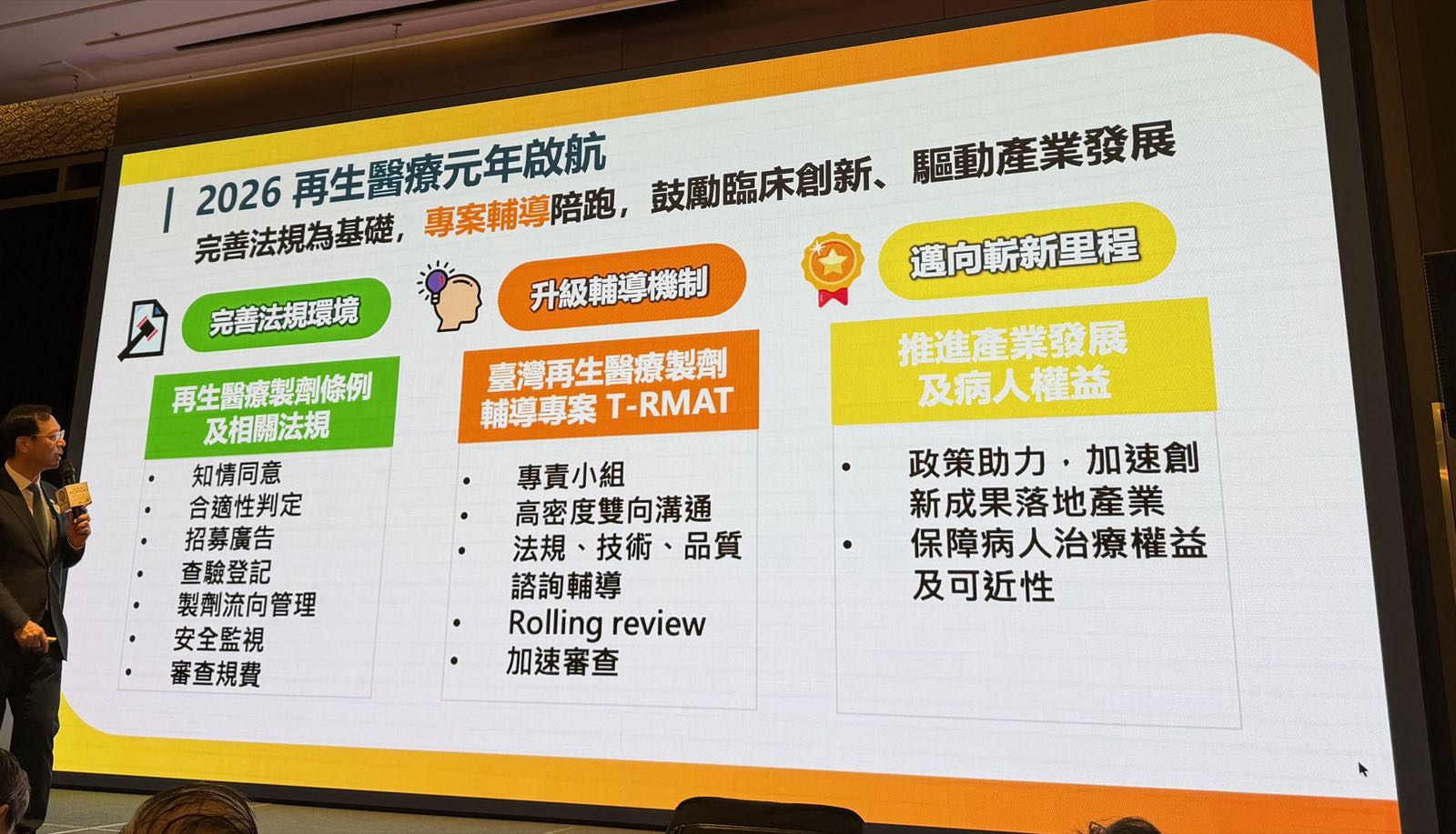 Slide 19 2026: The First Year of Regenerative Medicine Sets Sail
Slide 19 is organized around three layers:
Completing the Regulatory Environment: The Regenerative Medicine Products Act and related regulations, covering informed consent, eligibility determination, recruitment advertising, product registration, product traceability management, safety surveillance, and review fees.
Upgrading the Guidance Mechanism: The Taiwan Regenerative Medicine Accelerating Team, T-RMAT, encompassing a dedicated task force, high-frequency bilateral communication, regulatory and technical quality consultation, rolling review, and accelerated review.
Reaching a New Milestone: Policy support to accelerate the landing of innovative results in industry; protecting patients’ right to treatment and ensuring access.
Minister Shih:
“Guidance is therefore critical. We have established the Taiwan Regenerative Medicine Products Guidance Program. This is the founding year of regenerative medicine in Taiwan, so we hope that after the guidance process runs its course, we can see the first batch of conditional approvals before the end of this year.”
His word was “hope.” The slides list the component mechanisms of T-RMAT by name only, without describing how each operates in practice.
The Destination: Asia-Pacific Rare Disease Innovation Treatment Center
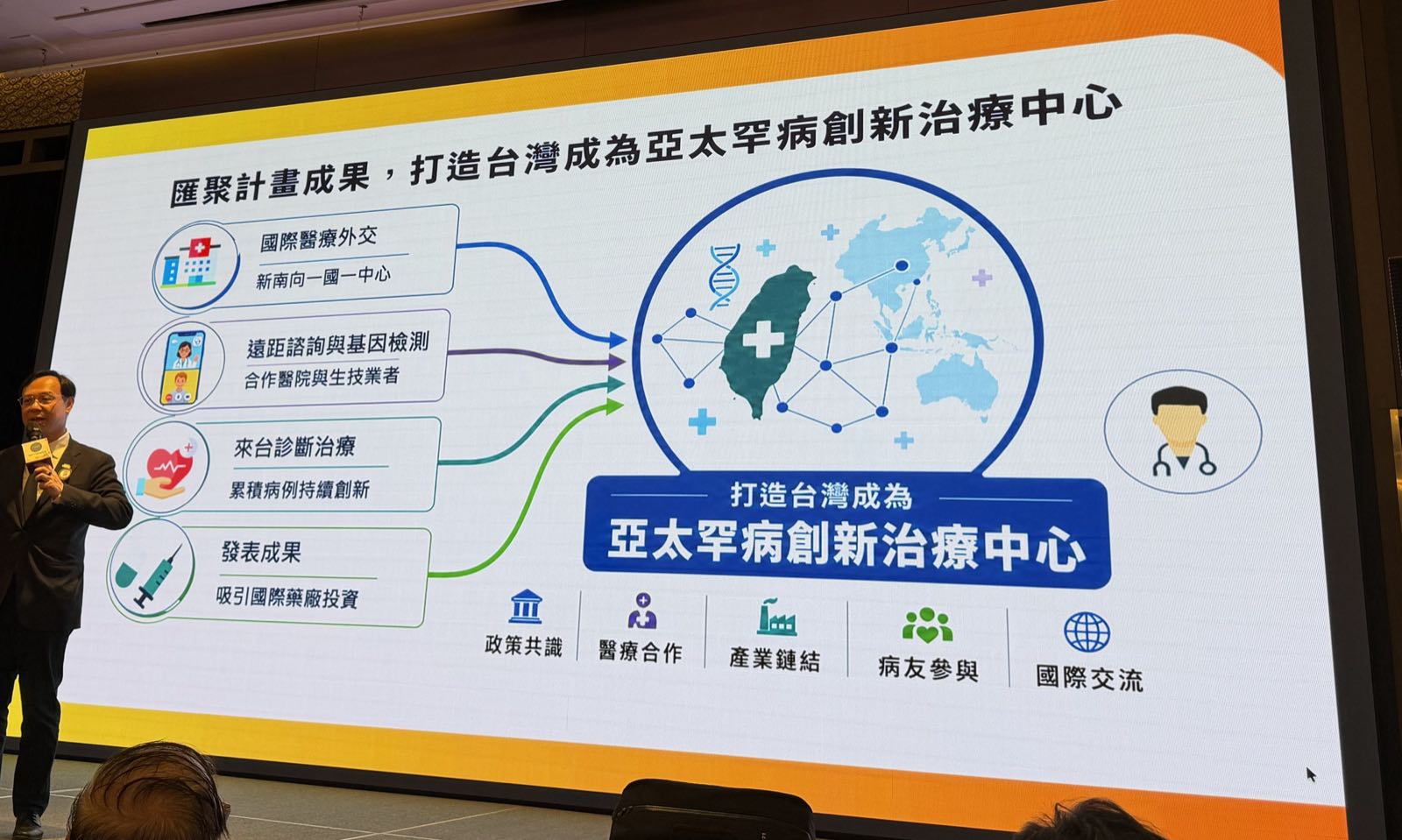 Slide 20 Building Taiwan into an Asia-Pacific Rare Disease Innovation Treatment Center
Slide 20 outlines four pathways:
- International Medical Diplomacy: One center per country, New Southbound Policy
- Remote Consultation and Genetic Testing: Partner hospitals and biotech companies
- Diagnosis and Treatment in Taiwan: Accumulating cases to sustain innovation
- Publishing Results: Attracting international pharmaceutical investment
Five pillars: policy consensus, medical cooperation, industrial linkage, patient participation, and international exchange.
The Minister explained why rare diseases are the endpoint:
“The ultimate goal is for Taiwan to become the Asia-Pacific center for rare disease innovation and treatment. Precision medicine has transformed the way we used to treat by the textbook — now it’s customized, individualized. So more and more conditions are becoming rare. Everyone can appreciate this: cancer is no longer a single disease. Breast cancer is no longer one disease, because genetic-level testing reveals that each variant is present in only a small number of cases.”
His closing remarks:
“So we want Taiwan’s innovations to look outward — to the Asia-Pacific and to the world. The greatest beneficiary is of course ourselves, but we are also sharing these medical technologies across the region and globally. That is what the industrial linkage, enterprise participation, and international exchange below all address. We have strategies in place for each.”
Key Facts
Each item below comes from the slides or the transcript, with the source indicated where the Minister spoke something not in the slides.
- The slides list nine cumulative marketing authorizations, three with NHI coverage dates noted and one (BEQVEZ) deregistered. Upstaza is labeled a point of national pride, originating from Professor Wuh-Liang Hwu’s team using Taiwanese clinical trial data, with EU marketing authorization granted on July 20, 2022.
- Ongoing INDs as of May 2026: 116 cell therapy, 65 gene therapy. The Minister said the numbers are “decent, but not enough,” and that “Phase III cases are comparatively hard to come by.”
- Spoken by the Minister, not in the slides: Three product prices — Zolgensma at NT$49 million per dose, Kymriah at NT$8 million, Upstaza at NT$100 million.
- Spoken by the Minister, not in the slides: The same therapy conducted in Taiwan would cost “roughly half or less, even one-third.” No basis for the estimate or comparison market was given.
- Spoken by the Minister, not in the slides: The target for the time from application to first patient enrollment is 180 days.
- Slides show the TACTC three-phase timeline: new case consultation recommending PIs and Sites in 5 to 7 business days; C-IRB primary review 4 to 6 weeks, secondary review 2 to 4 weeks (administrative and professional review concurrent); contracts 2 to 4 weeks, budgets 4 to 6 weeks. Nine feasibility evaluation cases already completed.
- National Development Fund four core strategies: early-stage intervention at TRL 4 to 6; integration of regulatory and clinical resources; NHI sandbox for domestic innovative medicine; mandated reinvestment of returns into the capital pool.
- The Minister “hopes” to see the first batch of conditional approvals before the end of 2026. The guidance mechanism is T-RMAT.
- The end goal is the Asia-Pacific Rare Disease Innovation Treatment Center, via four pathways: international medical diplomacy, remote consultation and genetic testing, in-Taiwan diagnosis and treatment, and publication of results.
Editor’s Observations
What follows is my own judgment and inference. None of it is said in the source material. Read it separately from the quotations and slide content above.
On the Upstaza case. It is the only complete example in this lecture of a therapy that used Taiwanese clinical trial data to obtain international marketing authorization. I had originally written that “this is precisely the model that the dual-track system and the early-phase strategy ultimately aim to replicate.” The source material does not say that. The slides simply label it a point of national pride. That connection is mine.
On the IND phase distribution. Cell therapy Phase I, Phase I/II, and Phase II combined account for 107 of 116 cases; Phase III accounts for only 8. That asymmetry is consistent with the Minister’s framing of Taiwan’s early-phase advantage. But the distribution describes only the current case structure. It does not, by itself, justify conditional approval as a policy tool — that is a policy choice, not a conclusion the data compels.
On pricing and NHI. The Minister acknowledged that high-cost therapies put pressure on the financial system, then pointed toward cost reduction as the direction. I had once framed this as “the government has two options — restrict reimbursement or lower costs — and he chose the second.” That either/or structure is my construction. Similarly, “without building the domestic industry, these therapies will remain accessible only to a few” is my inference, not his argument.
On the scope of the cost argument. The Minister said “if treatment is conducted in Taiwan.” I had expanded this to “keeping manufacturing and treatment in Taiwan is what creates room to compress prices.” The manufacturing dimension is something I added. He spoke only about treatment.
On the 180-day target and TACTC. The 180-day figure is a verbal target. The TACTC three-phase timeline is slide content. The two are not explicitly connected in the source material. Calling TACTC “the institutionalization of 180 days” is my connection. As for whether the three phases fit within 180 days (roughly 25.7 weeks): the slides do not clarify whether primary and secondary review, or contracts and budgets, run in parallel or in sequence. Different assumptions produce different totals, so I won’t offer a figure that looks more precise than the evidence supports. And the three phases are only part of the full pipeline from application to enrollment — they are not the complete picture.
On rare diseases and population scale. The Minister’s logic is that precision medicine, by drilling down to the genetic level, turns each disease variant into a small-population condition. I had inferred from this that “Taiwan’s disadvantage in overall population size therefore diminishes.” The inference is actually unstable: fewer patients can just as easily mean harder enrollment, not easier. The source material provides no data to determine the direction. I flag this as an open question rather than a conclusion.
On “Diagnosis and Treatment in Taiwan.” Slide 20 describes this as part of an international medical cooperation pathway. I had rewritten it as treating the Asia-Pacific region as a “patient enrollment catchment area” — which turns an international medical diplomacy concept into a clinical trial recruitment strategy. The slides do not say that.
On the year-end time point. The Minister said “hope,” not “commitment.” Other time-bound statements appear in the lecture (the 180-day target, the BTC conference two weeks out). This one is not uniquely specific. But the regulatory framework took effect in January 2026, and the hope for a first batch of conditional approvals within the same calendar year is, for an outside observer, one of the few policy outcomes from this lecture that can be checked against a particular date.
Series: Global Trends and Taiwan’s Position · The Design Logic of the Dual-Track System

💬 Comments
Loading...