
TL;DR — In 2025, Asia-Pacific registered 990 regenerative medicine clinical trials, surpassing North America’s 916 for the first time. Breaking the numbers down: China grew 20% in the second half of the year; the US grew 8%. Minister of Health and Welfare Shih Chung-liang read this reversal as “both an opportunity and a concern,” and gave Taiwan’s direction: not chasing Phase 3, but strengthening the country’s existing advantages in Phase 1 and Phase 2 early-phase trials.
On August 15, 2026, Minister of Health and Welfare Shih Chung-liang addressed the 2026 Life Sciences, Intellectual Property, and Brand Finance International Summit on the topic of “Advancing the Regenerative Medicine Act and Aligning with International Standards” — a 22-minute talk across 20 slides. This is the first of three summaries, covering slides 1 through 6 and the opening segment of the lecture.
Earlier in this series, I worked through the authority map of regenerative medicine and the conditional approval pathway. These three pieces deal with the first official public explanation of how that same regulatory framework is operating after going live. More records of this kind are collected under Contemplation and Memory.
A note on source layers
- Text in quotation marks represents Minister Shih’s spoken remarks, transcribed from the verbatim record.
- Unquoted descriptions draw from the original slide deck or transcript. Several details on slide 2 appeared only in the original slide graphic and have been reconstructed from it here.
- My own judgments and inferences are confined entirely to the “Editor’s Observations” section at the end, separate from the main body.
Why Does Taiwan’s Regenerative Medicine Story Begin in 2018?
 Slide 1 — Lecture cover: Advancing the Regenerative Medicine Act and Aligning with International Standards
Minister Shih placed the starting point of Taiwan’s regenerative medicine development in 2018.
“For regenerative medicine, Taiwan’s real starting point — of course, we had been running clinical trials for a long time before — but the real starting point was 2018, before the pandemic. That was the year we revised the Special Regulations, which allowed autologous cell therapy to enter clinical use. Under a set of strict standards, Taiwan moved from conducting clinical trials to being able to apply these therapies clinically.”
He then acknowledged that problems remained: “But we still ran into many issues, including procedurally cumbersome processes and limited scalability, among others.”
That set the stage for a dual-law, dual-track framework. He explained the rationale for going with two tracks: “In view of the inherent differences between cell therapy and conventional small-molecule drugs, we adopted a dual-track regulatory system — one for technology, one for pharmaceutical products.” The goal was “to shorten the gap between clinical trials and product approval. The ultimate aim is early access — giving more people the opportunity to receive treatment when they need it.”
The mechanics of the dual-track system are covered in the second article. This piece stays with the first six slides: what evidence the minister used to argue why action is needed now.
What Key Challenges Is the Post-Pandemic Global Healthcare System Facing?
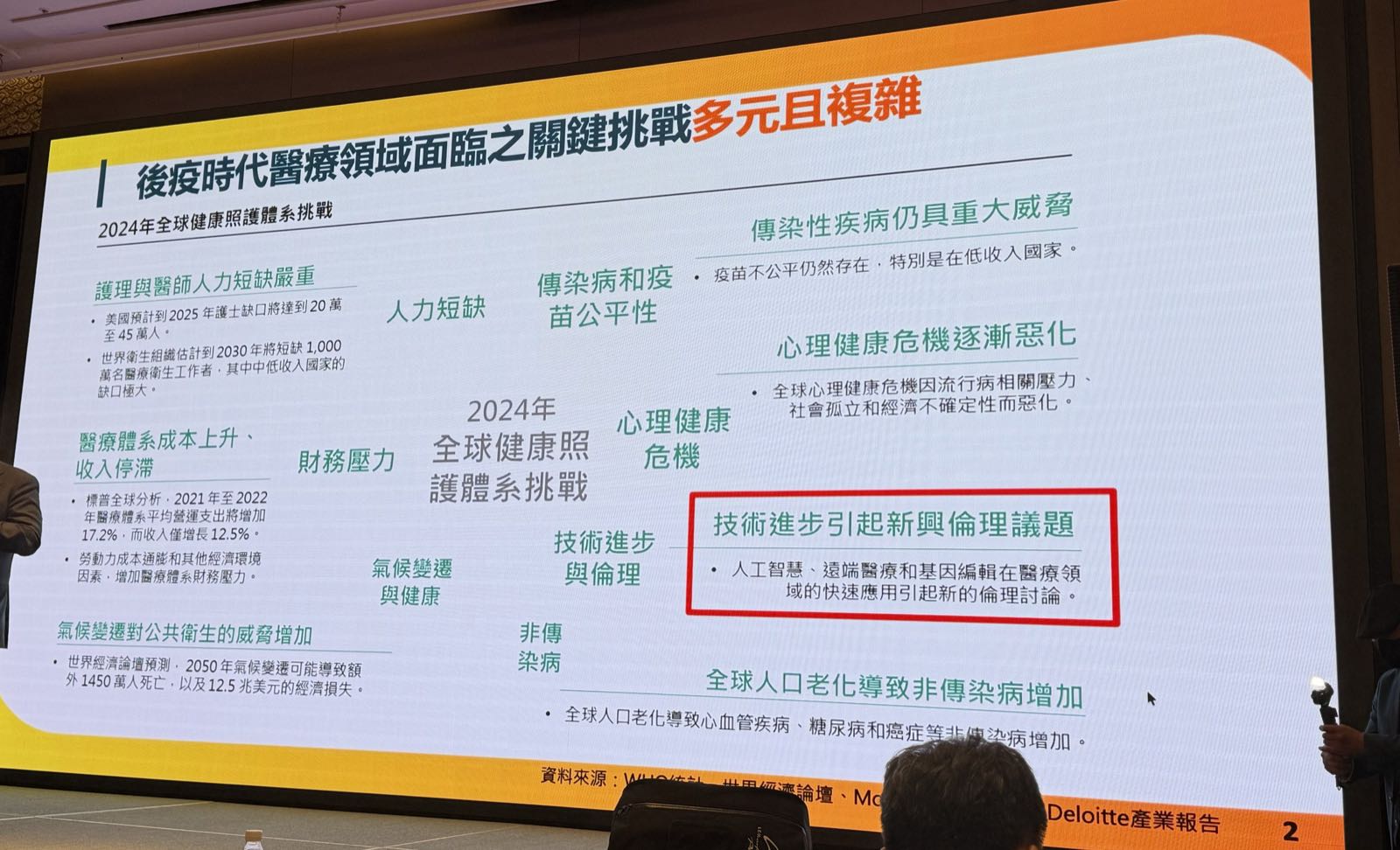 Slide 2 — Key challenges facing the medical sector in the post-pandemic era
Slide 2 listed the key challenges confronting the global healthcare system in 2024, with the subtitle “Diverse and Complex.” Seven items appeared on a central wheel diagram: workforce shortages, financial pressure, infectious diseases and vaccine equity, the mental health crisis, technological advancement and ethics, climate change and health, and non-communicable diseases.
Three of the seven carried supporting figures.
Workforce shortages. The United States projects a nursing shortfall of 200,000 to 450,000 by 2025. The World Health Organization estimates a global deficit of 10 million health workers by 2030, with the gap most severe in low- and middle-income countries.
Financial pressure. Cited as S&P Global analysis: between 2021 and 2022, average healthcare system operating expenses rose 17.2%, while revenue grew only 12.5% — a gap of 4.7 percentage points. The original slide also listed labor cost inflation and other economic factors as adding to the financial strain on healthcare systems.
Climate change. The World Economic Forum projected that by 2050, climate change could cause an additional 14.5 million deaths and USD 12.5 trillion in economic losses.
The item highlighted with a red box on the slide was a separate one: technological advancement giving rise to new ethical questions — specifically, the rapid adoption of artificial intelligence, telemedicine, and gene editing in medicine, and the ethical debates they are producing.
(Sources: WHO statistics, World Economic Forum, McKinsey industry reports, Deloitte industry reports.)
On this slide, Minister Shih offered the following remarks:
“I believe the twenty-first century is an enormously important moment in the history of medicine. The immortality drugs we once only imagined are becoming real, one after another, and they are landing in practice. Think about the robots you saw in Star Wars — they are walking around beside us now. These are things we spent a long time imagining, but in this century of medical progress we can actually see them, one by one.”
He added: “But alongside these advances, many new ethical controversies have emerged, and these are things we must take seriously. So we face challenges, and at the same time we have opportunities. The particular opportunity — the policy question — is how to guide the development of regenerative medicine as a field and as an industry.”
Taiwan’s Challenges and Opportunities
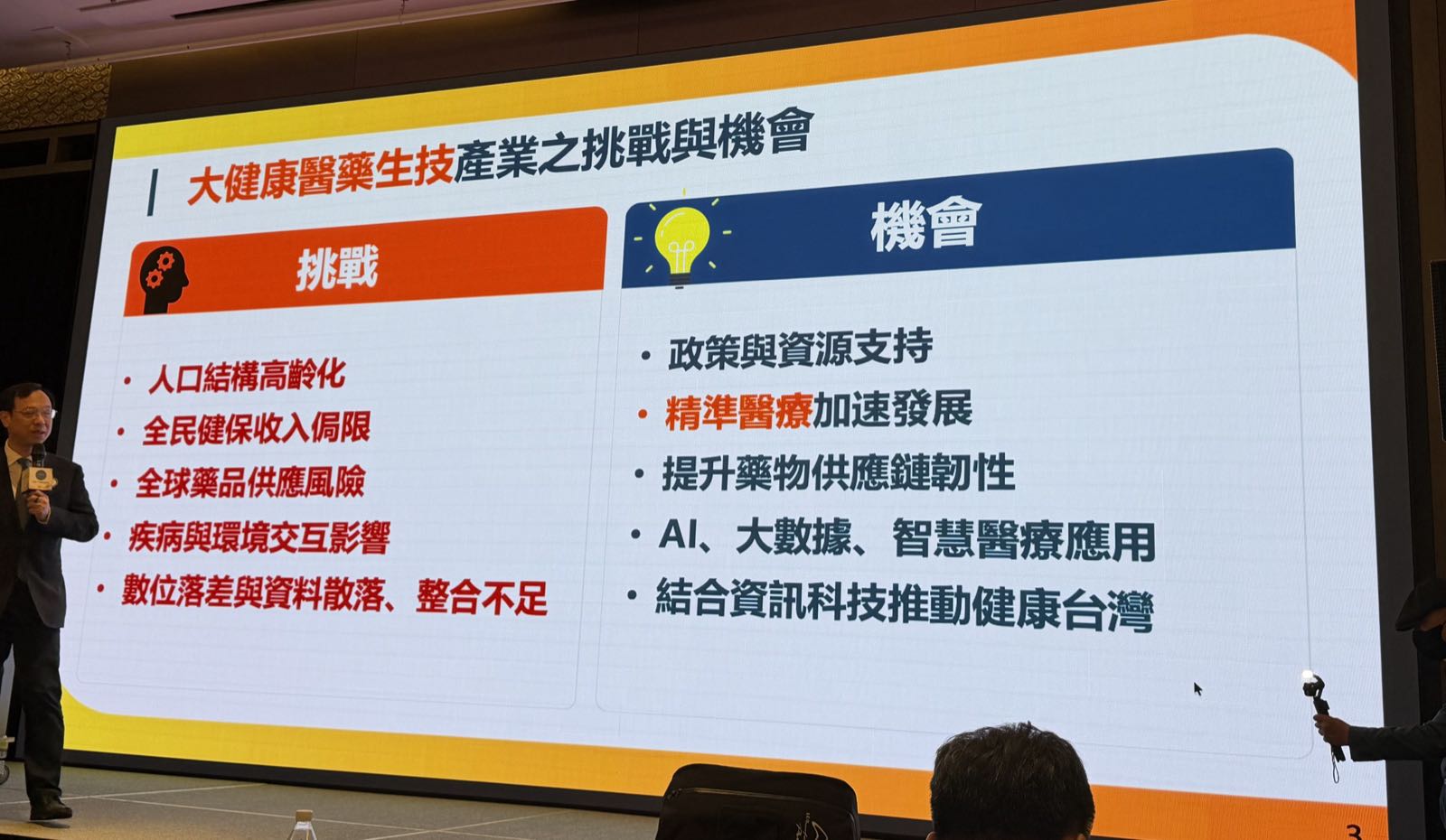 Slide 3 — Challenges and opportunities for the greater health, pharmaceutical, and biotech industry
Slide 3 brought the context back to Taiwan.
Challenges: an aging population; capped revenue under National Health Insurance; global pharmaceutical supply risks and the interplay of disease and environment; the digital divide, scattered data, and insufficient integration.
Opportunities: policy and resource support, accelerating precision medicine; strengthening pharmaceutical supply chain resilience; AI, big data, and smart healthcare applications; advancing a Healthy Taiwan agenda through information technology.
11.5% and 34%: Which Market Does Each Growth Rate Describe?
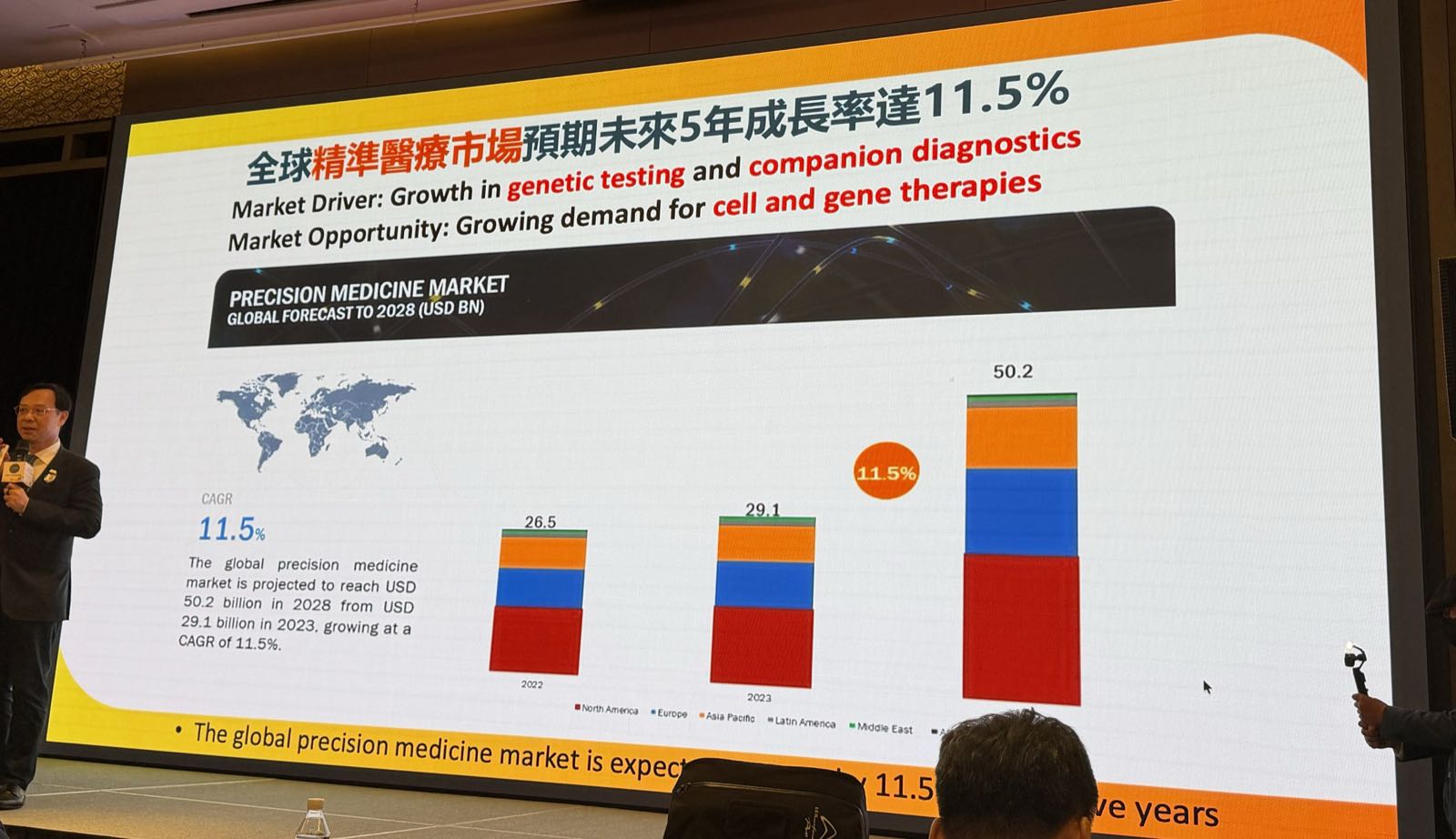 Slide 4 — The global precision medicine market is projected to grow at 11.5% over the next five years
Slide 4 covers the precision medicine market. Global market size was USD 26.5 billion in 2022, USD 29.1 billion in 2023, and is projected to reach USD 50.2 billion by 2028, at a CAGR of 11.5%. Growth drivers include expanding genetic testing and companion diagnostics; opportunities come from rising demand for cell and gene therapy. The regional breakdown spans North America, Europe, Asia-Pacific, Latin America, the Middle East, and Africa. (Source: Precision Medicine Market, Global Forecast to 2028.)
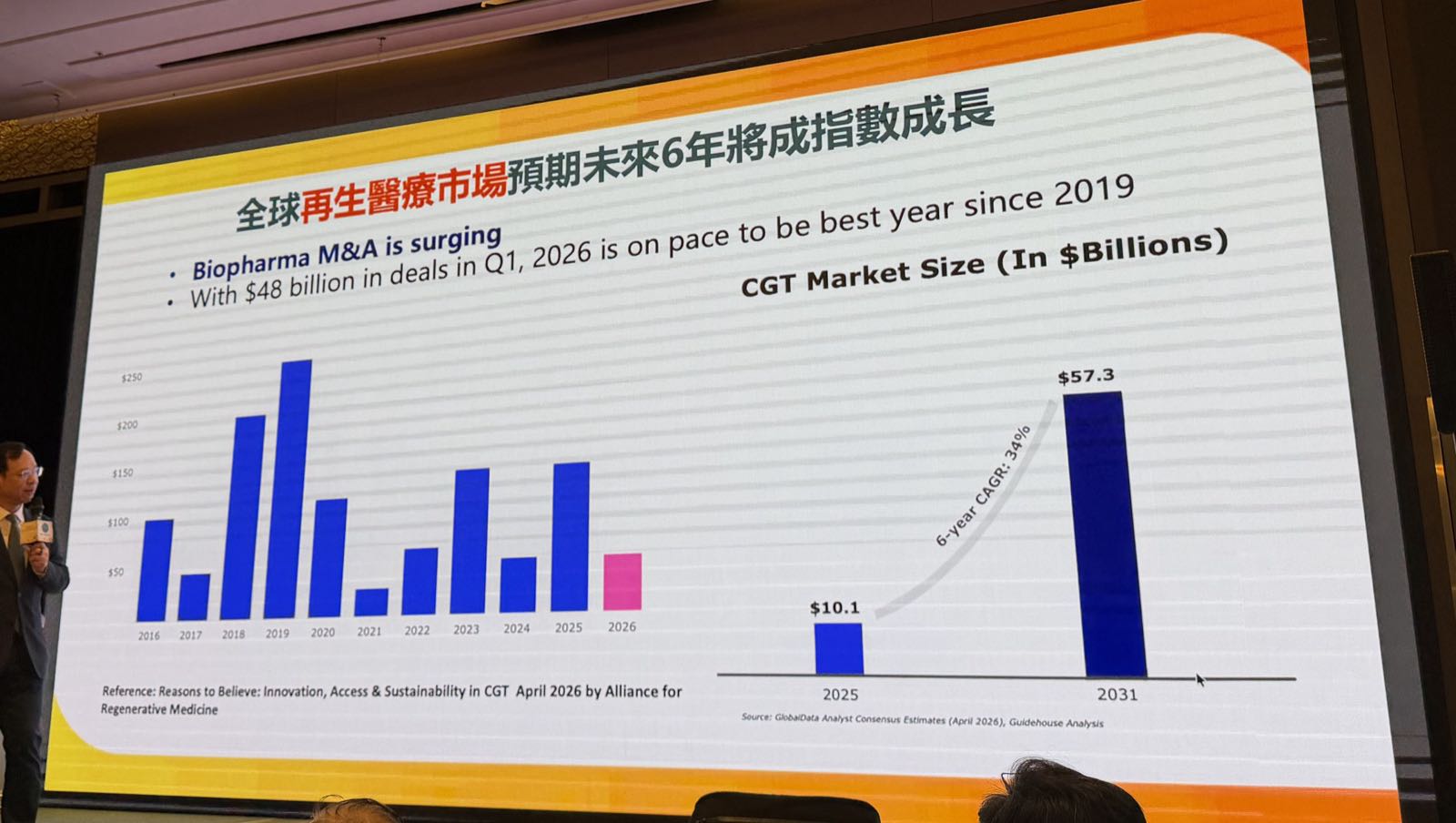 Slide 5 — The global regenerative medicine market is projected to grow exponentially over the next six years
Slide 5 covers the regenerative medicine market. The cell and gene therapy (CGT) market stood at USD 10.1 billion in 2025 and is projected to reach USD 57.3 billion by 2031, a six-year CAGR of 34%. The same slide noted that biopharma M&A activity is accelerating, with Q1 2026 deal value already reaching USD 48 billion — on pace to be the strongest year since 2019. (Sources: Alliance for Regenerative Medicine, Reasons to Believe: Innovation, Access & Sustainability in CGT, April 2026; GlobalData Analyst Consensus Estimates, April 2026; Guidehouse Analysis.)
On stage, Minister Shih discussed both figures together:
“At the time, the forecast was for growth at 11.5%… but this year’s forecast is different. You can see that, taking 2025 as the baseline and projecting six years forward to 2031, the growth rate for those six years is 34%. You’ll remember the earlier figure was 11.5% — that was from just after the pandemic. Looking ahead today, once we’ve emerged from that period, the projected growth is 34%.”
One point needs to be stated clearly: 11.5% refers to the precision medicine market, and 34% refers to the CGT regenerative medicine market. These are two different markets, not two successive forecasts for the same one. The minister presented the two slides in sequence during the live talk. Anyone citing these figures should trace them back to their respective slides in the original deck. The transcript annotation flags this as well.
When Did Asia-Pacific Clinical Trials Surpass North America?
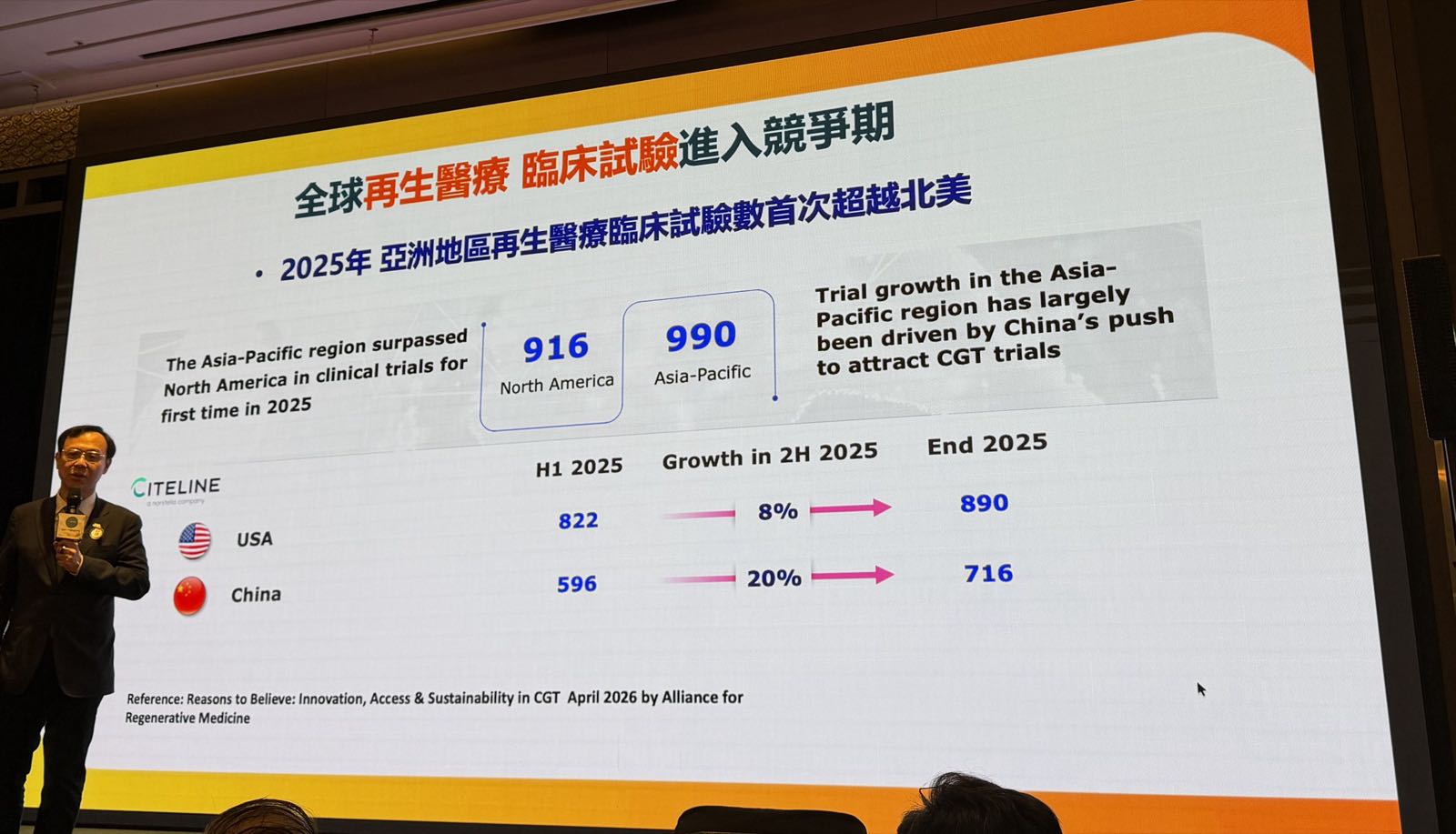 Slide 6 — Global regenerative medicine clinical trials enter a competitive phase
In 2025, Asia-Pacific regenerative medicine clinical trial counts surpassed North America for the first time: 916 in North America, 990 in Asia-Pacific.
- United States: 822 trials in the first half of 2025; 8% growth in the second half; 890 by year-end.
- China: 596 trials in the first half of 2025; 20% growth in the second half; 716 by year-end.
The slide attributed Asia-Pacific trial growth primarily to China’s success in attracting CGT trials. (Sources: Citeline; Alliance for Regenerative Medicine, April 2026 report.)
Minister Shih’s reading of this slide:
“This tells us that Asia-Pacific is a rapidly growing market for this industry going forward. But for Taiwan, it is both an opportunity and a concern — because, as you can see, China is growing even faster. The bottom of this slide compares the US and China: the US is growing steadily, but China’s pace is something else entirely. This shows us that Taiwan has real advantages, but also real concerns.”
(The minister referred in the room to “the report from Q1 of this year.” According to the transcript annotation, slide 6 presents full-year 2025 data, drawn from a source report published in April 2026.)
Why Is Taiwan Betting on Early-Phase Clinical Trials?
Given this landscape, Minister Shih laid out Taiwan’s direction:
“So on the clinical side, the goal is not only to move quickly toward real-world application under strong regulatory management, but also to strengthen early-phase clinical trials. Taiwan’s medical strength lies in early-phase trials — Phase 1 and Phase 2. Phase 3, on the other hand, turns on case numbers. The enrollment requirements are typically large, and Taiwan’s population is relatively small.”
“So we need to work with greater precision. What we are building is what I would call precision clinical trials — and from there, bridging toward eventual market approval. That is the policy we have designed in response to these trends.”
The minister did not elaborate on what “precision clinical trials” means in practice.
Later in the talk, when discussing conditional approval, he used the phrase “overtaking on a curve” to characterize this strategy — a detail taken up in the third article.
Key Source Points
All items below come from the original slide deck or the verbatim transcript.
- Minister Shih placed the starting year of Taiwan’s regenerative medicine development in 2018, when the Special Regulations were revised and autologous cell therapy entered clinical use.
- The rationale for the dual-track regulatory framework, in the minister’s words, was “the inherent differences between cell therapy and conventional small-molecule drugs.”
- Slide 2 listed seven key challenges facing the global healthcare system in 2024; three carried supporting figures: workforce shortages, financial pressure, and climate change.
- The two growth rates refer to different markets: precision medicine at 11.5% (2023 to 2028, USD 29.1 billion to USD 50.2 billion); CGT regenerative medicine at 34% (2025 to 2031, USD 10.1 billion to USD 57.3 billion).
- Asia-Pacific regenerative medicine clinical trials surpassed North America for the first time in 2025 (990 vs. 916). The US moved from 822 to 890 (8% second-half growth); China moved from 596 to 716 (20% second-half growth). The slides identified China as the primary driver of Asia-Pacific growth.
- The minister stated that Taiwan’s advantages lie in Phase 1 and Phase 2 trials; Phase 3 is constrained by enrollment scale and Taiwan’s smaller population. The direction is to build on early-phase strengths and develop “precision clinical trials” to bridge toward market approval.
Editor’s Observations
What follows is my own judgment and inference. The source material does not say these things. Read this section separately from the quotations and slide content above.
On the two growth rates. When the minister presented both figures together, the point he seemed to be making was that the scale has shifted: just after the pandemic, we were looking at low double-digit growth; now, looking at regenerative medicine specifically, we’re looking at over 30%. That contrast works as a policy argument. But since the two numbers belong to different markets, they do not, strictly speaking, constitute before-and-after forecasts for the same target. Demonstrating a scale shift would require two forecasts for the same market at different points in time. The source material does not provide that.
On China’s growth rate. Second-half growth of 20% versus 8% is a 2.5x difference in rates. Calculated instead by absolute trial count increases (China +120, US +68), the ratio falls to 1.76x. The two methods yield different multiples, but point in the same direction: the “Asia-Pacific surpasses North America” headline was driven primarily by forces that have nothing to do with Taiwan.
On the early-phase strategy. The minister did not define “precision clinical trials.” Placing that phrase back in the full context of the lecture, I read it as describing a pathway: complete early-phase trials quickly and well, then use conditional approval to enable products to enter the market after Phase 2, followed by real-world evidence to build out the evidentiary base post-approval. This is my reconstruction. The source material does not explicitly connect these three stages into a single pathway.
On population as a constraint. The minister said Phase 3 trial “case numbers are typically large, and Taiwan’s population is relatively small.” At one point in my drafting I wrote this up as “enrollment capacity is capped by population size — not something effort can overcome.” That absolutism was mine. Later in the same talk, the minister did discuss multi-center collaboration and digitizing enrollment processes — both of which address exactly this constraint. Population is a disadvantage, but the source material does not support framing it as an unsolvable ceiling.
On the relationship between ethics and regulation. The minister presented technological advancement and ethical controversy side by side, and the subsequent items — pre-review of advertising, cell source management, information disclosure — do each point toward protecting the public. But bundling all three under “responding to ethical controversy” is a causal chain I added. The source material gives each item its own rationale: preventing misleading claims, preventing errors, protecting patients.
Next in the series: The Design Logic of the Dual-Track System · Funding, Speed, and the Asia-Pacific Rare Disease Innovation Treatment Center

💬 Comments
Loading...