
311.4 million tonnes of CO₂ equivalent. That is the cumulative and projected greenhouse gas total for Russia’s full-scale invasion of Ukraine, from February 2022 through February 2026 — four years of war. It is roughly equal to France’s entire annual emissions, or half of Germany’s.
This number didn’t come from any government’s press office. It was produced by the Initiative on GHG Accounting of War, a team combining Ukraine’s environmental organization Ecoaction with international researchers. The methodology was first presented publicly at COP29 in 2024 and has been updated at intervals since. I reviewed their latest report — the forty-eighth month update, released after the four-year mark, covering through February 2026 — and the numbers check out.
Those 310 million tonnes break down across six categories. Military operations — diesel and jet fuel burned by tanks, aircraft, and armored vehicles — account for 37%, or 114.1 million tonnes, the single largest source. Post-war reconstruction comes second at a projected 73.3 million tonnes (23%), though none of that spending has actually occurred yet; these are estimated future costs. Landscape fires triggered by combat follow closely at 70.3 million tonnes, also roughly 23%. Ukraine’s wildfires burned through 1.39 million hectares in 2025, far above pre-war levels; drought made the fires harder to suppress. The research team estimated this figure by comparing data from conflict zones versus non-conflict zones and factoring in degraded firefighting capacity during wartime — not by tracing the origin of every individual fire. The remaining 17% is divided among aviation rerouting, damage to energy infrastructure, and refugee displacement.
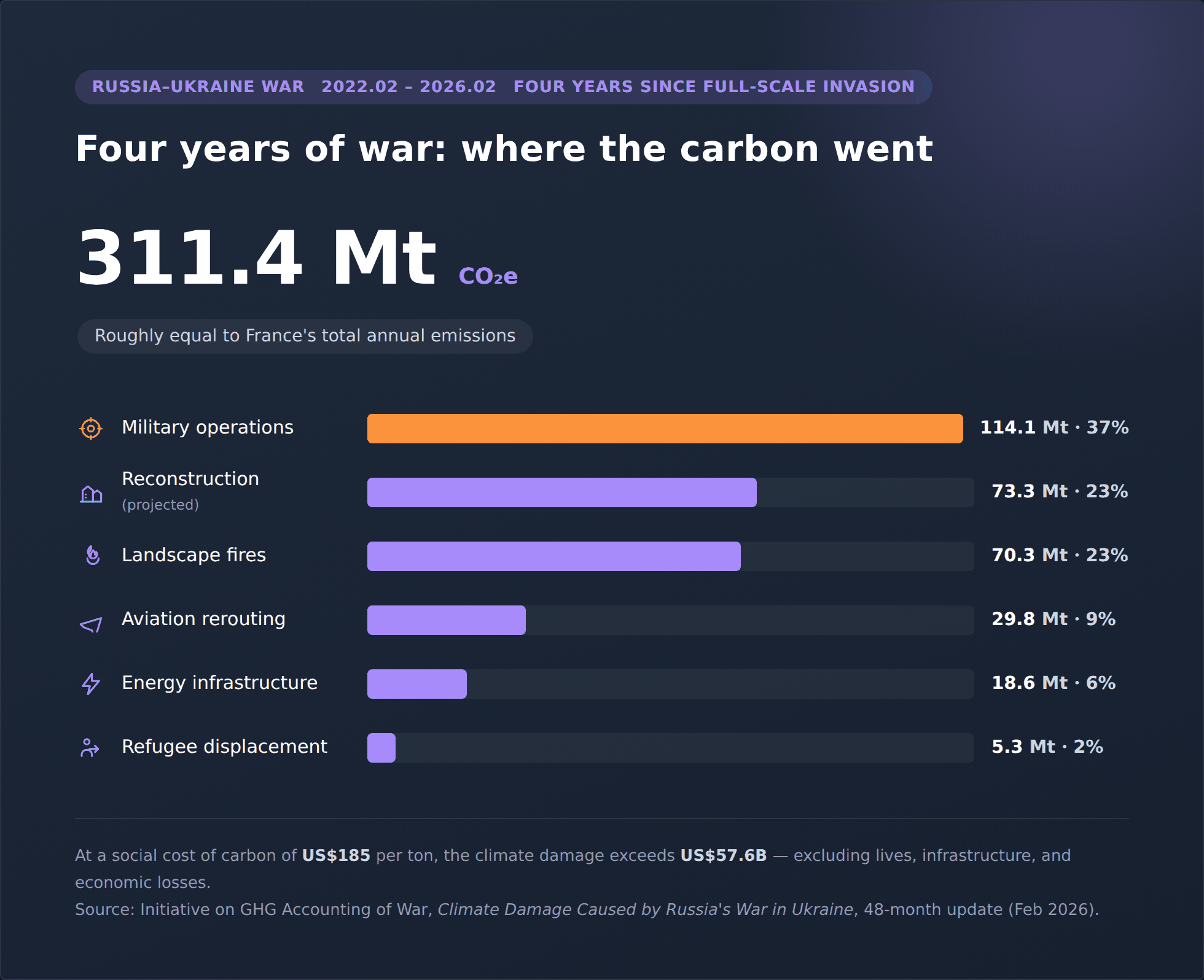
At a social cost of carbon of $185 per tonne, the climate damage exceeds $57 billion. That covers only the climate dimension — no lives, no homes, no economic losses. This $57 billion figure comes from the latest report (through February 2026). When Ukraine announced at COP30 last November that it would incorporate this kind of accounting into the Register of Damage for Ukraine — an international reparations mechanism led by the Council of Europe — as one line item in its claims against Russia, it was citing an earlier version of the report: $43.8 billion and 240 million tonnes, both lower than the current figures. To my knowledge, formally submitting war-related carbon emissions as the basis for reparations claims against an aggressor state is genuinely uncommon. COP29 in November 2024 put the methodology on the table; COP30 in November 2025, roughly a year later, turned it into a reparations instrument.
When I work through carbon issues with business owners, we rarely start by calculating emissions. We start by deciding where to draw the boundary. Does the coal the factory burns on-site count? What about the raw materials a supplier ships in? Employee commutes? Every layer you push outward adds another layer of dispute. The war accounting team faced exactly the same problem, only harder: fuel for tanks is straightforward enough, but do you include wildfires ignited by combat? The concrete for future reconstruction? Each of those choices is itself a position. This report drew the boundary broadly, including landscape fires and projected reconstruction. The reasoning is laid out in the report, available for scrutiny.
Climate conversations typically sort emissions into two buckets: industrial and lifestyle. This report is a reminder that there is a third: violence itself. A tank’s diesel, a burning field, a factory bombed and then rebuilt — all of it is going into the atmosphere. And those emissions don’t stop when a ceasefire is signed. The steel and concrete for reconstruction are the next wave of the ledger.
When countries negotiate emissions reduction targets at climate summits, “fighting one fewer war” almost never appears in anyone’s cost-benefit analysis. The 73.3 million tonnes for reconstruction is still a projection. When the concrete trucks actually roll into Kyiv, the numbers will be revised. A war’s carbon debt doesn’t settle on the day the guns go quiet.
Peace is the most effective climate policy.
References
- Initiative on GHG Accounting of War, Climate Damage Caused by Russia’s War in Ukraine (48-month update, 2026.02)
- Planetary Security Initiative, Climate damage caused by Russia’s war in Ukraine
- Earth.org, 3 Years On, War Is Largest Source of Carbon Emissions in Ukraine

💬 Comments
Loading...