
TL;DR — In the 1970s, an engineer given six months to live traveled to Europe, learned to bake bread, and built a diet that brought him back to health. His story shaped fermentation master Shiga Katsuei’s thinking on food as medicine, and it underlies the slow bread at 味覺的感動.
In the 1970s, a Japanese man named Ōchi Shūzō (おおち・しゅうぞう) was working on automatic train control systems for the Shinkansen. Then his doctors told him he had cancer. He had six months to live.
He had heard that wheat bran, wheat germ, and lactic acid bacteria might do the body some good. So he went to Italy and Austria to learn breadmaking, assembled a bread-centered diet for himself, and slowly nursed his health back. He eventually became an authority on what came to be called the Ōchi-method: a practice of health and nourishment built around bread.
I came across this story in a book by Shiga Katsuei. Shiga writes that it was through Ōchi that he first truly grasped how much the symbiosis of lactic acid bacteria and yeast matters to the human body. Who Shiga Katsuei is, and how his work came to be connected to a bakery in Taipei, I wrote about in the first piece of this series.
Can bread be medicine?
Using bread as medicine sounds like folk remedy territory. That is not what Shiga is talking about.
Around the age of fifty, he placed “food as medicine” at the center of his breadmaking. The idea is simple: the body is built from what it eats, digests, and absorbs. Eating well, then, is a way of caring for the body. Better to put your money into a loaf that genuinely does you good than to spend it on treatments after things have already gone wrong.
But he holds one line: the bread cannot be medicine-shaped. Whatever a craftsman makes must first taste good. Health comes second. A wholesome bread that tastes bad is pointless.
Why slow is healthier
So what, exactly, makes that bread good for the body? The answer keeps coming back to slowness. In the second piece of this series, I wrote about why a fast-moving age paradoxically calls for slow fermentation. Here I want to look at what slowness means for the body itself.
Fermentation is a whole ecosystem at work, not a solo act by a single microbe. A dough is home to at least two groups of microbes at once: yeasts, which metabolize sugars into carbon dioxide and alcohol, making the bread rise and carrying flavor; and lactic acid bacteria, which metabolize sugars into lactic acid, giving the bread its sourness and suppressing stray microbes in the dough. The two live in symbiosis, each indispensable. That in itself is a complex system, not something a single variable can explain.
| Category | Microbe | Examples | Role in bread fermentation |
|---|---|---|---|
| Facultative anaerobe | Yeast | Saccharomyces cerevisiae, wild yeasts (e.g. Candida humilis) | Produce carbon dioxide to make the bread rise; metabolize alcohols, esters, and other flavor compounds |
| Aerotolerant / facultative anaerobe | Lactic acid bacteria | Lactobacillus sanfranciscensis, L. plantarum, L. brevis | Metabolize sugars into lactic acid (homofermentative) or lactic acid plus CO₂/acetic acid/alcohol (heterofermentative); provide sourness, suppress spoilage microbes, and are the focus of gut microbiome research |
| Obligate aerobe | Acetic acid bacteria | Acetobacter genus | Oxidize alcohol into acetic acid; the dough interior is oxygen-poor, so this group usually plays a minor role, though it can appear in openly cultured natural leavens |
Bread made with industrial yeast alone reduces this entire ecosystem to a single strain: it can make bread rise in a few hours, but leaves no time for the lactic acid bacteria to get involved. Fast, but impoverished.
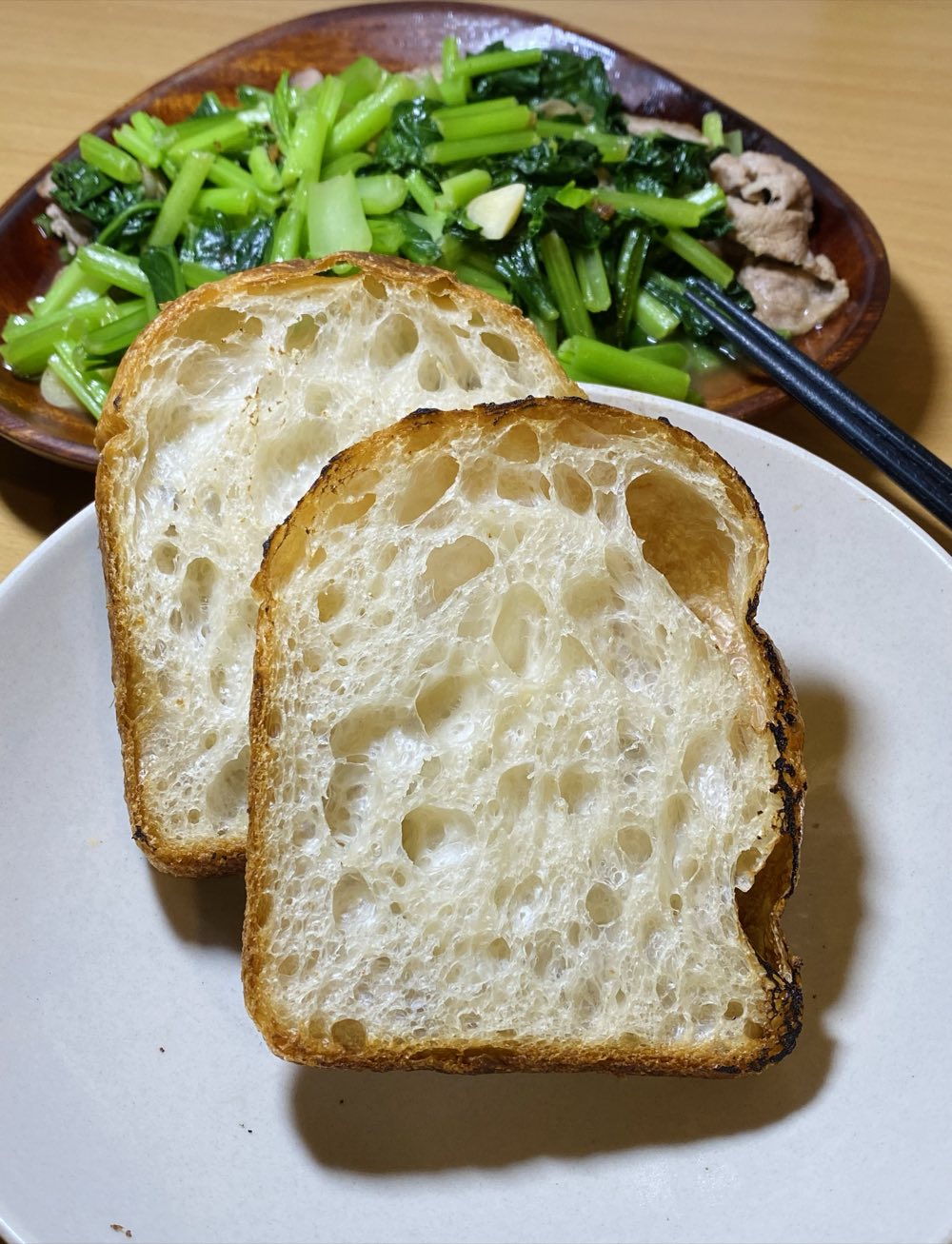
Low-temperature, long fermentation preserves lactic acid bacteria. Those bacteria do more than drive fermentation: they help regulate the gut and give the body a measure of protection against pathogens. Given enough time, starches break down into glucose, and the bread develops a natural sweetness on its own, with no added sugar needed. Whole-wheat flour with its bran intact also carries considerably more minerals than refined white flour.
味覺的感動’s bread (18°C, 18 hours) follows exactly this approach. They sent it out for SGS testing, and the results showed lactic acid bacteria levels more than six times higher than those found in conventionally made bread.
There is a certain irony here. The pure white loaf we tend to associate with cleanliness and refinement is actually a recent invention. Shiga notes in his book that truly snow-white bread was, in a sense, invented in postwar France: achieved through high-degree milling combined with high-speed mixing. Before that, the bread people ate was darker, bran-included, and closer to what we would now call the healthier kind.
Gut microbiome research has become a major field in recent years for good reason. A 2021 randomized controlled trial by Stanford researchers, published in Cell, split 36 healthy adults into two groups and tracked them for 17 weeks: one ate a high-fiber diet, the other ate fermented foods. Only the fermented-food group showed a steady rise in microbiome diversity along with a drop in inflammation markers; the high-fiber group saw no meaningful improvement in diversity, no matter how much fiber they ate. The researchers’ reading is that the fermentation process itself, not just the bacteria count, may be what matters.
📊 Key Data
- Stanford 2021 RCT: 36 healthy adults; after 17 weeks, the fermented-food group showed a steady rise in microbiome diversity and a drop in inflammation markers, while the high-fiber group showed no meaningful improvement (Wastyk et al., Cell, 2021)
- Human Microbiome Project: the NIH formally launched it in 2007; the gut microbiome has been a systematic field of study for barely two decades
Ōchi Shūzō’s diet dates to the 1970s. All he had to offer was his own body; there was no laboratory data behind it. The systematic science took nearly half a century to catch up: the NIH did not launch the Human Microbiome Project, formally establishing the gut microbiome as a field of research, until 2007. The Stanford trial was not published until 2021. Testimony came before evidence, by the better part of a lifetime.
You do not have to wait until something goes wrong
I have spent more than a decade in the food and agriculture industry. Bread does not cure disease. Ōchi Shūzō’s recovery through bread was his personal experience, not a general prescription.
Since becoming involved with 味覺的感動, though, the phrase “food as medicine” means something different to me than it used to. It is not about treating food as a drug. It is about recognizing that what goes into the body every day is slowly, quietly building the body. That is easy to forget until something breaks down. Shiga and the people around him did not wait for that moment: a bread made with multiple yeasts, fermented long enough, free of additives, making good food a daily ordinary thing rather than a remedy.
References and Further Reading
Shiga Katsuei and Signifiant Signifié (Japan)
- Signifiant Signifié official website: Founded by Shiga Katsuei in Setagaya, Tokyo in 2006, with “food as medicine” as its guiding philosophy.
- Official YouTube channel: Video introductions to the bakery and Shiga Katsuei.
- Interview with Shiga Katsuei, “このひとの世田谷” (世田谷くみん手帖): On low-temperature long fermentation and “eating to sustain health.”
- Shiga Katsuei, パンの世界:基本から最前線まで (Kodansha Sensho Méthié, 2014): The primary source for this essay; the Ōchi Shūzō account appears in Shiga’s own words in Chapter 2 (「日本のパンの可能性」, The Potential of Japanese Bread), section 「発酵食品としてのパン」. Publisher’s official book page.
Video
- “シニフィアンシニフィエのパン作り ミキシングから焼成まで”: Documents Shiga Katsuei’s process from mixing through baking.
Taiwan (Taiwan-Japan connection)
- 從酵母思考麵包的製作 by Shiga Katsuei, Traditional Chinese edition (books.com.tw)
- 志賀勝榮的麵包, Traditional Chinese edition (books.com.tw)
- “味覺的感動: Does healthy have to mean flavorless?” (iCook Living, 2020): Interview with Chef Lisa on the 18°C/18-hour fermentation method, the 6.2× lactic acid bacteria finding, and food as medicine.
Ōchi Shūzō and the Ōchi-method
- “おおち法とは” (ヘイゼルパン): A record of the long-fermentation method developed and patented by Ōchi Shūzō and Ōchi Keiko.
- Ōchi Shūzō’s bread books (held by the National Diet Library of Japan): Kyōi no Pan Yaki-hō (Shogakukan, 1977) and at least three more, across three publishers, confirming the author and his works are real.
SGS Test Reports (commissioned by 味覺的感動, 2016)
What was tested was the fermented dough, not the baked bread; the figures reflect fermentation depth, as explained in the FAQ above.
- 📄 18-hour fermented dough · lactic acid bacteria 3.7×10⁶ CFU/g, yeast 1.5×10⁶ CFU/g (SGS FA/2016/80143): SGS Taiwan Food Lab, tested per the Taiwan MOHW official method (Notice No. 1021950329).
- 📄 12-hour fermented dough · lactic acid bacteria 3.4×10⁶ CFU/g, yeast 9.3×10⁵ CFU/g (SGS FA/2016/80142)
The material in this essay about Ōchi Shūzō, food as medicine, and long-fermentation breadmaking is drawn from Shiga Katsuei’s パンの世界:基本から最前線まで (Kodansha Sensho Méthié) and represents the author’s paraphrase, not a word-for-word translation. Lactic acid bacteria testing figures are cited from 味覺的感動’s official communications. This essay is not medical advice.

💬 Comments
Loading...